
Environmental Resilience, Climate and Sustainability


ABSTRACT
Urban flooding can occur when short-duration rainfall produces runoff faster than local drainage and storage systems can safely accommodate it. SINK (Smart Intelligent Network for Rainwater Capture and Flood Mitigation) is proposed as a closed-loop infrastructure framework coupling short-horizon rainfall/runoff-risk prediction with controllable local storage. Forecast-informed real-time rainwater-harvesting control is already established; therefore, SINK is not presented as a first-of-its-kind smart-tank concept. Its proposed research contribution is the explicit integration of local drainage-state feedback, uncertainty-aware emergency-capacity allocation, distributed storage control, a hard hydraulic safety supervisor, and causal benchmarking that separates passive storage, automated control and AI-assisted optimization. The intended prediction horizon is 60 min with a 5-min operational control interval, subject to catchment travel time and forecast skill. A synthetic numerical proof-of-concept uses a 1-ha catchment, 200 m³ storage capacity and a 45-mm five-step rainfall event. Under the stated assumptions, peak discharge is 0.200 m³/s for the no-storage baseline, 0.133 m³/s for passive storage, 0.120 m³/s for predictive rule control, and 0.100 m³/s for an illustrative AI/MPC case. These values demonstrate internal feasibility only. Calibrated SWMM simulation and field measurements are required before any empirical effectiveness claim
Keywords: Urban Flooding; Rainwater Harvesting; Artificial Intelligence; Real-Time Control; Model Predictive Control; Iot; Detention Storage; SWMM; Uncertainty; Climate Resilience
INTRODUCTION
Urban flooding occurs when rainfall-generated runoff exceeds the capacity of drainage, storage and infiltration systems. Source-control measures such as rainwater harvesting, detention and green infrastructure can reduce the rate and volume of runoff reaching overloaded drainage networks. At the same time, AI and data-driven models are increasingly used for rapid flood and drainage prediction. The engineering question addressed here is how prediction can be converted into a physically safe local intervention.
Xu demonstrated forecast-informed real-time control of rainwater-harvesting systems, including the use of rainfall forecasts to release stored water before storms and evaluation of different forecast windows [1]. This prior work means that forecast-based pre-release, smart storage and automated rainwater control cannot be claimed as individual novelties. The revised SINK hypothesis is narrower: short-horizon AI flood-risk estimates, local drainage-state sensing, uncertainty margins and distributed storage control may form a useful action layer between flood forecasting and physical mitigation, provided all AI commands remain subject to explicit hydraulic constraints.
Research Problem
Can an uncertainty-aware closed-loop controller use short-horizon flood-risk information to allocate local storage capacity before and during rainfall while satisfying downstream hydraulic constraints and improving physical flood outcomes relative to equivalent passive storage?
Objectives
- Quantify the incremental benefit of storage, automated predictive control and AI-assisted optimization under identical rainfall and storage conditions.
- Define a reproducible short-horizon prediction problem for runoff and drainage/flood risk.
- Formulate explicit decision variables, objective terms and hydraulic constraints for control.
- Validate the concept first in a calibrated hydraulic digital twin and then with hardware-in-the-loop and field measurements.
- Evaluate engineering outcomes rather than prediction accuracy alone.
LITERATURE REVIEW AND REFINED NOVELTY
Forecast-Informed Real-Time Control
Xu is directly relevant because it shows that real-time control can use rainfall forecasts to pre-release rainwater-harvesting storage and improve flood-related performance [1]. SINK therefore does not claim novelty from forecast-based pre-release itself. The proposed distinction is the coupling of the control decision to local drainage state, an explicit uncertainty representation, a safety supervisor with final authority, and a common benchmark that uses equal storage capacity to isolate the incremental value of each layer.
AI Urban-Flood Prediction
Anik review the evolution toward machine-learning, real-time and hybrid approaches in urban flood prediction [2]. SINK does not claim that LSTM, gradient boosting or hybrid AI is individually novel. Instead, the prediction layer is treated as a control input whose physical consequences are evaluated through a hydraulic model.
SWMM
Niazi reviewed SWMM applications and reported its broad use for urban drainage modelling [3]. The citation is corrected in this revision to the Journal of Sustainable Water in the Built Environment, with the complete author list and DOI.
Specific contribution relative to prior systems
|
Existing capability |
Established function |
SINK-specific research contribution |
|
Forecast-informed rainwater RTC |
Forecasts can trigger pre-release. |
Add local drainage-state feedback, uncertainty margins and a safety supervisor. |
|
AI flood prediction |
Predict runoff, water level or inundation. |
Convert prediction into constrained physical storage actions and evaluate the physical outcome. |
|
Passive storage |
Retain and reuse stormwater. |
Treat free storage as a dynamically managed emergency-capacity resource. |
|
Hydraulic simulation |
Test drainage/storage scenarios. |
Use equal-capacity counterfactuals to separate storage, automation and AI/MPC effects. |
|
IoT monitoring |
Observe rainfall, levels and flows. |
Close the loop from sensing to prediction to constrained actuation. |
The contribution is therefore an integration/control hypothesis, not a claim that each constituent technology is new.
Proposed SINK System
Revised architecture
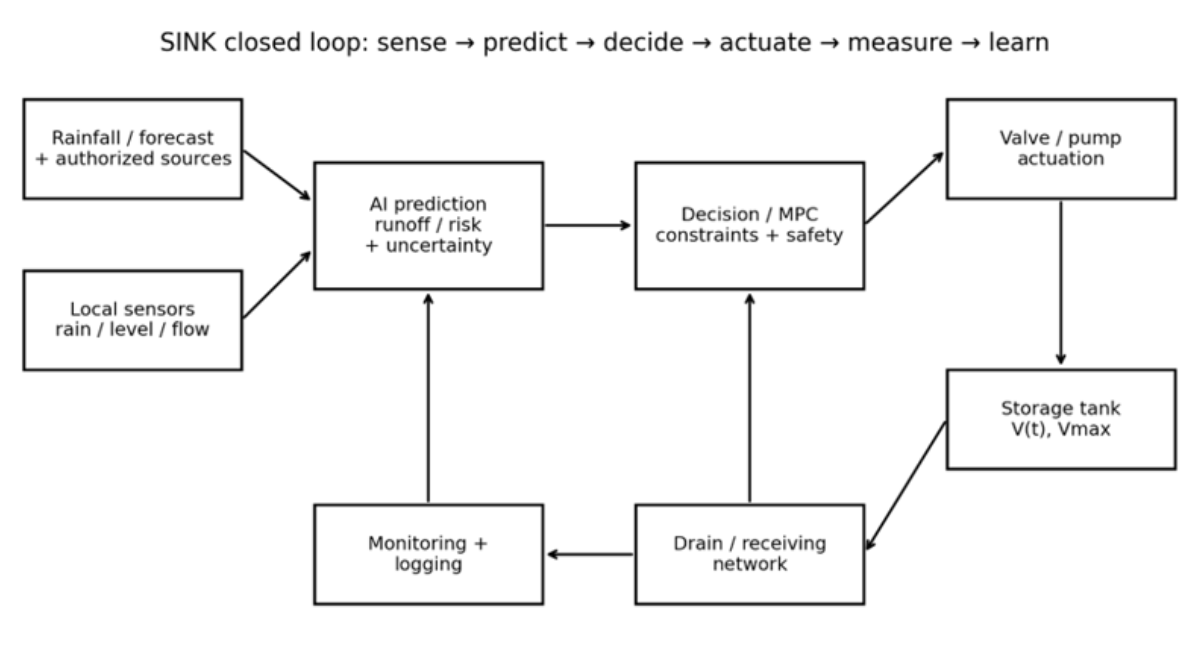
Figure 1: Revised SINK Architecture with Explicit Feedback from Storage and Drainage State to Prediction and Control
Components And Operating Modes
- Rainfall sensing; authorized forecast/nowcast interface; water-level and flow sensing.
- Catchment context: DEM, imperviousness, land use, drainage topology and historical flood observations.
- Storage tank/detention unit with protected overflow, controlled outlet and redundant critical sensing.
- Edge PLC/controller implementing hard safety limits independently of cloud connectivity.
- AI prediction layer estimating runoff/risk and uncertainty.
- Decision/MPC layer selecting pre-release, capture and discharge actions.
- Dashboard, event logging, alarms and maintenance monitoring.
- Normal, pre-storm, storm, post-storm and fail-safe operating modes
Ai Prediction Methodology
Target And Horizon
The initial research target is drainage/tank water level and runoff state over a 60-min horizon, with predictions at 5-min increments. The operational control interval is 5 min. The horizon must ultimately be selected from catchment travel time and verified forecast skill; if safe pre-release requires more time than forecast lead time provides, the action is not considered feasible [4].
ŷ_(t+h) = fθ(X_t, F_t), h = 5, 10, …, 60 min
The critical-event probability is p_flood(t+h)=P(y_(t+h)≥y_critical | X_t,F_t). The model should provide a prediction interval or quantiles so that control uses a conservative upper estimate rather than a point prediction alone.
Candidate Models
|
Model |
Role |
Selection basis |
|
XGBoost/LightGBM |
Interpretable baseline |
Error, calibration, inference time |
|
LSTM/GRU |
Sequential baseline |
Temporal error and robustness |
|
Hybrid/physics-informed AI |
Preferred research direction |
Prediction + physical consistency + uncertainty |
|
SWMM |
Hydraulic digital twin |
Calibration and independent validation |
Training and validation
Use chronological rather than random splits: earlier storms/seasons for training, later storms for validation and a held-out season/extreme-event set for final testing. With multiple sites, add spatial cross-validation. Rare-event imbalance should be handled through event-based sampling, class weighting or threshold optimization [5].
Hydraulic and Storage Formulation
Corrected Water Balance
With Q_overflow defined as a positive outflow leaving the tank:
dV/dt = Q_in − Q_out − Q_use − Q_overflow
V is stored volume; Q_in is inflow; Q_out is controlled discharge; Q_use is permitted reuse withdrawal; and Q_overflow is emergency overflow. All outflow terms are positive magnitudes and therefore enter the balance with negative signs. The normal constraint is 0 ≤ V(t) ≤ V_max
Runoff and emergency-capacity target
For screening, Q_p=C i A. For final validation, use calibrated SWMM.
V_free(t)=V_max−V(t)
V_target(t)=min[V_max, V_reserve + V_U,event(t)]
V_U,event is an uncertainty-adjusted upper estimate of forecast runoff. Pre-release is allowed only when downstream capacity remains safe.
Explicit Control Variables and Constraints
Decision vector at each control step: u_t=[q_release,t, q_use,t, q_capture,t
- 0 ≤ V_t ≤ V_max
- 0 ≤ q_release,t ≤ q_release,max
- Q_downstream,t + q_release,t ≤ Q_down,max(t)
- V_t ≥ V_reserve during designated critical periods
- Actuator rate-of-change and switching limits are respected
- Overflow remains available through an independent protected hydraulic route
Intelligent Control and MPC
Rule-Based Baseline
If predicted risk is Normal, maintain the normal storage target. If risk reaches Warning and free capacity is insufficient, initiate controlled drawdown if downstream conditions permit. If risk reaches Critical, prioritize safe capture and restrict non-essential discharge.
MPC formulation
At each 5-min step, optimize U={u_t,…,u_(t+N−1)} over the 60-min horizon:
min_U J = Σ_h [w_f R_(t+h) + w_q(Q_out,t+h−Q_safe)^2 + w_e E_t+h + w_w L_t+hw_u||Δu_t+h||²]
R is predicted flood-risk exposure; Q_out is controlled discharge; E is actuation energy; L represents avoidable water loss relative to reuse targets; and Δu penalizes aggressive actuator changes. The objective is constrained by the storage balance, storage bounds, downstream discharge limit, pump/valve limits and minimum emergency reserve [6].
Lead-time feasibility
If V_release must be removed at a safe discharge q_safe, minimum release time is t_release=V_release/q_safe. An intervention is actionable only if forecast lead time exceeds t_release plus a sensor/communication/verification margin.
Numerical Proof-Of-Concept
To address the reviewer's request for quantitative feasibility evidence, a transparent synthetic benchmark is added. It is deliberately labelled illustrative: it is not a calibrated SWMM result, field measurement or trained-AI result. The purpose is to separate the causal contributions of storage, automated predictive control and AI/MPC under equal storage capacity.
|
Parameter |
Value |
|
Catchment area |
1 ha (10,000 m²) |
|
Runoff coefficient |
0.80 |
|
Rainfall event |
5, 10, 15, 10, 5 mm/h; 10-min steps |
|
Total rainfall |
45 mm |
|
Storage capacity |
200 m³ for B–D |
|
Passive initial storage |
100 m³ |
|
Predictive-control initial storage |
20 m³ after safe pre-release |
|
Illustrative downstream threshold |
0.12 m³/s |
|
Control interval in screening |
10 min |
The inflow is Q_in=C i A/3600. Scenario A has no controllable storage. B uses the same 200 m³ capacity with 100 m³ initially occupied and a fixed 0.05 m³/s outlet. C begins at 20 m³ after forecast-informed pre-release and uses a 0.12 m³/s controlled outlet. D uses the same initial state and an illustrative 0.10 m³/s MPC command. No AI model is trained in this screening experiment.
|
Scenario |
Peak discharge |
Overflow |
Threshold-exceedance volume* |
Peak reduction |
|
A: No SINK |
0.200 m³/s |
0.0 m³ |
64.0 m³ |
0.0% |
|
B: Passive storage |
0.133 m³/s |
110.0 m³ |
16.0 m³ |
33.3% |
|
C: Forecast rule control |
0.120 m³/s |
0.0 m³ |
0.0 m³ |
40.0% |
|
D: AI/MPC control* |
0.100 m³/s |
0.0 m³ |
0.0 m³ |
50.0% |
*Time-integrated discharge above the illustrative 0.12 m³/s threshold; it is not a calibrated inundation/flood volume.
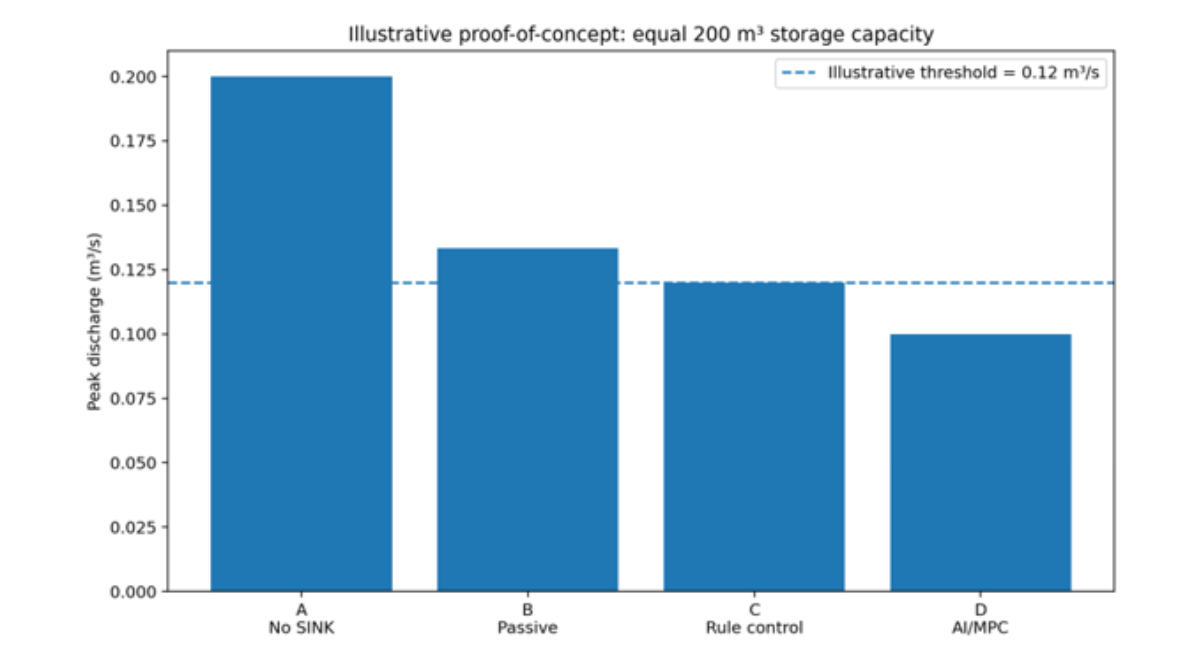
Figure 2: Illustrative Numerical Proof-Of-Concept. Equal Storage Capacity Is Used In All Storage-Controlled Scenarios
Interpretation: passive storage reduces the peak relative to the no-storage case, but its pre-event state leaves less emergency capacity. Predictive control adds the ability to create free capacity before the event. The illustrative MPC case further limits the controlled discharge. These results establish internal feasibility of the proposed control logic, not generalizable flood-mitigation performance [7].
Full Validation Methodology
|
Scenario |
Storage |
Control |
Purpose |
|
A: Baseline |
None |
None |
Reference flood response |
|
B: Passive |
200 m³ |
Fixed rule |
Isolate storage benefit |
|
C: Predictive rule |
200 m³ |
Forecast + rules |
Isolate automated pre-release benefit |
|
D: AI/MPC |
200 m³ |
AI risk + constrained MPC |
Test incremental AI/optimization benefit |
Build and calibrate a SWMM digital twin using observed rainfall, water level and flow. Validate on independent events before running counterfactual A–D simulations. Use identical catchment, rainfall, storage and actuator assumptions across scenarios.
Metrics
- Peak discharge reduction (%)
- Flood-threshold exceedance volume/duration
- Storage utilization
- Prediction MAE/RMSE and F1
- False-alarm and missed-event rate
- Actionable lead time
- Actuator response time
- Energy per event
- Water recovered for reuse
- Sensor/controller availability
Safety, Uncertainty and Cybersecurity
- AI commands cannot override hard hydraulic constraints.
- Protected overflow must remain functional without electronic control.
- Critical installations should use redundant level sensing.
- Pre-release is prohibited when downstream conditions are unsafe.
- Loss of communication must not create an unsafe hydraulic state.
- Forecast uncertainty must enter the required-capacity calculation.
- Remote commands must be authenticated, encrypted and logged.
- Local safety control has final authority over dangerous states.
DISCUSSION
The revised positioning is intentionally conservative. Prior forecast-informed real-time rainwater-harvesting research means SINK should not be described as the first smart-tank or forecast-control concept. Its proposed contribution is a systems-engineering bridge between forecasting and physical mitigation: the prediction layer estimates risk and uncertainty, local sensors update the state, a constrained controller allocates storage capacity, and a safety supervisor limits the action space [8].
The equal-capacity benchmark is important because otherwise a larger tank could be mistaken for an AI benefit. In the proposed experimental design, storage capacity is held constant across B–D, allowing the incremental effect of control logic to be examined. The final scientific test is therefore not whether SINK predicts accurately, but whether better prediction and control produce statistically and hydraulically meaningful improvements across independent storm events [9,10].
LIMITATIONS
The numerical example is synthetic and uses simplified rainfall-runoff conversion. It does not represent a calibrated pipe network, spatial inundation, real forecast error, actuator dynamics or field sensor noise. The AI component is not trained in this manuscript. Consequently, no field effectiveness or statistical significance is claimed. Those claims require the validation program described above.
CONCLUSION AND FUTURE WORK
SINK is presented as an uncertainty-aware, safety-constrained framework for predictive rainwater storage and urban flood mitigation. The revised manuscript explicitly recognizes prior forecast-informed real-time control and narrows the research contribution to integrated local drainage-state feedback, uncertainty-aware capacity allocation, constrained actuation and causal benchmarking. A synthetic numerical proof-of-concept demonstrates that the control logic is mathematically feasible, while also making clear that calibrated simulation and field data are required for scientific validation.
Future work should select a pilot catchment, collect multi-season data, calibrate a SWMM digital twin, benchmark baseline AI models, quantify forecast uncertainty, implement rule control and constrained MPC, perform hardware-in-the-loop testing, and conduct controlled field trials with reproducible model/configuration information.
Appendix A. Reproducibility
Use the rainfall sequence [5,10,15] mm/h at 10-min intervals, A=10,000 m², C=0.80, Vmax=200 m³ and the stated initial storage/outlet policies. Update storage by V_(i+1)=V_i+(Q_in,i−Q_out,i−Q_use,i−Q_overflow,i)Δt, with Q_use=0 in the screening event and overflow activated only when V exceeds Vmax. This reproduces the values in Table 3.
|
Reviewer comment |
Revision |
|
1. Novelty and Xu et al. (2020) |
Xu et al. added and discussed explicitly; forecast-informed RTC is acknowledged as prior art. SINK novelty is narrowed to uncertainty-aware local drainage feedback, safety supervision and equal-capacity causal benchmarking. |
|
2. No quantitative demonstration |
Added synthetic numerical proof-of-concept and four-scenario comparison. Clearly labelled illustrative, not calibrated/field evidence. |
|
3. Water-balance sign |
Corrected to dV/dt = Q_in − Q_out − Q_use − Q_overflow and defined positive outflow convention. |
|
4. Reproducibility |
Specified 60-min prediction horizon, intended 5-min operational control interval, uncertainty handling, decision variables, MPC objective/constraints and lead-time feasibility. |
|
5. Bibliography |
Corrected Anik et al. to Environmental Systems Research and Niazi et al. to Journal of Sustainable Water in the Built Environment (2017), with complete authorship and DOI. |
|
6. Figure 1 |
Replaced with a legible closed-loop architecture showing feedback from storage/drainage state to prediction and control. |
REFERENCES
- Xu WD, Fletcher TD, Burns MJ, Cherqui F. Real time control of rainwater harvesting systems: The benefits of increasing rainfall forecast window. Water Resour Res. 2020;56(9):e2020WR027856. [Crossref]
- Anik MSBM, An C, Li SS. Evolution from the physical process-based approaches to machine learning approaches to predicting urban floods: a literature review. Environ Syst Res. 2025;14:15. [Crossref]
- Niazi M, Nietch C, Maghrebi M, Jackson N, Bennett BR, Tryby M, et al. Storm Water Management Model: Performance Review and Gap Analysis. J Sustain Water Built Environ. 2017;3(2). [Crossref]
- U.S. Environmental Protection Agency. Storm Water Management Model (SWMM). EPA; 2023.
- U.S. Environmental Protection Agency. Green Infrastructure and Clean Water Act Requirements Resources. EPA; 2024.
- India Meteorological Department. Urban Flooding and IFLOWS. Government of India; 2025.
- Piadeh F, Bakhtiari V, Behzadian K, Piadeh F. AI-assisted framework using physically informed rainfall-drainage features for real-time urban flood risk forecasting. J Hydrol. 2026;677:135819.
- Yao X, Yang L, Tan J, Xie Z, Gan C, Wen P, et al. Bayesian-optimized BiLSTM-U-Net framework for urban flood prediction with spatio-temporal feature integration. J Hydrol. 2026;135175.
- Zheng Y, et al. A knowledge-based deep learning model for accurate urban drainage system prediction under spatiotemporally variable rainfall. Water Res. 2026;300:125930.
- Ashok SP. Application of Deep Learning and Rain-On-Grid Hydrodynamic Modeling for Catchment-Scale Flood Forecasting in Guwahati, India. J Flood Risk Manag. 2026. [Crossref]