About the Journal
Overview
The Journal of Environmental Resilience, Climate and Sustainability (JECS) is a peer-reviewed, international, open-access journal dedicated to advancing high-impact research, critical insights, and innovative solutions that address the interconnected challenges of environmental change, climate dynamics, and sustainable development. As global ecosystems face increasing pressure from climate variability, pollution, resource depletion, and urban expansion, the journal provides a multidisciplinary platform for researchers, policymakers, engineers, environmental scientists, economists, and social scholars to share knowledge and promote actionable strategies for a resilient future
The Journal of Environmental Resilience, Climate and Sustainability publishes high-quality original research articles, systematic reviews, case studies, policy analyses, technical reports, and perspectives that explore key themes such as climate change adaptation and mitigation, ecosystem resilience, biodiversity conservation, renewable energy systems, sustainable land and water management, circular economy approaches, climate-smart agriculture, disaster risk reduction, and environmental governance. It also emphasizes emerging areas including green technologies, carbon neutrality pathways, nature-based solutions, environmental monitoring, and climate-resilient infrastructure development.Recognizing that environmental challenges are deeply linked with social, economic, and political systems, the journal strongly encourages interdisciplinary submissions that integrate environmental science with public policy, urban and regional planning, behavioral sciences, indigenous knowledge systems, climate finance, and sustainable development goals (SDGs). This holistic approach ensures that scientific findings are translated into practical solutions that benefit both ecosystems and communities, particularly those most vulnerable to environmental change.
Each manuscript submitted to the journal undergoes a rigorous peer-review process conducted by experts in relevant fields to ensure scientific quality, originality, and global relevance. In alignment with its open-access model, all published content is freely available to researchers, practitioners, educators, and policymakers worldwide, promoting the rapid dissemination of knowledge and accelerating environmental action.With growing global urgency around climate resilience and sustainability transitions, the Journal of Environmental Resilience, Climate and Sustainability serves as a vital bridge between research and real-world impact. It provides a platform for advancing innovative thinking, supporting evidence-based policy, and fostering collaborative solutions for a more resilient, sustainable, and equitable planet.
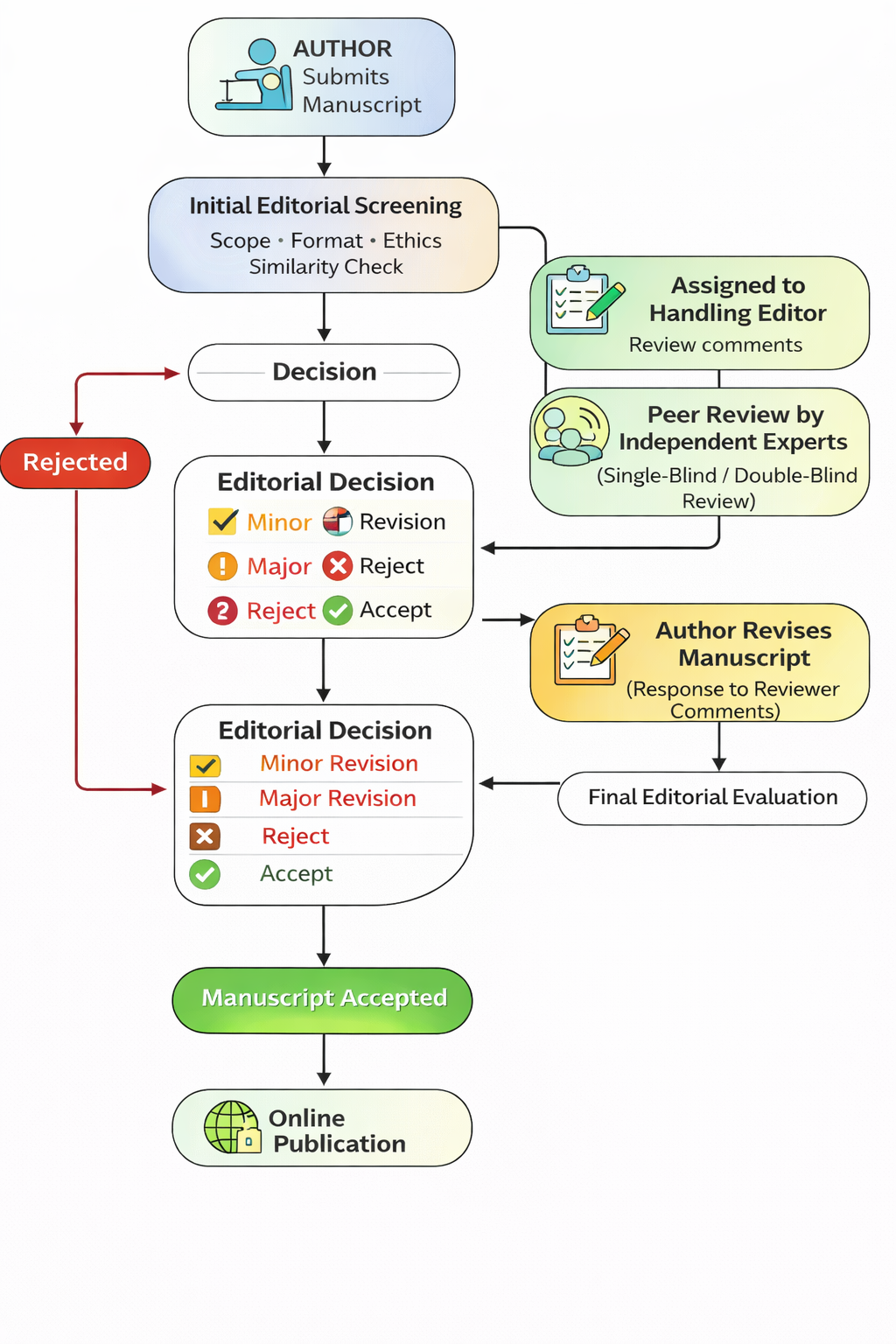
Editorial and Peer-Review Policy
Environmental Resilience, Climate and Sustainability adheres to a strict single-blind peer-review process to maintain the quality, integrity,
and scientific validity of all published work.
Key features include:
-
Each manuscript is reviewed by at least two independent experts in the field,
along with an academic editor.
-
Reviewers know who the authors are, but the authors remain unaware of the reviewer's
identities.
-
The evaluations emphasize scientific merit, originality, methodological rigor, ethical
compliance, and how well the work fits within the journal's scope.
-
Every submission goes through plagiarism checks and ethical compliance assessments
before the review process begins.
-
The final decision on publication is based on the reviewer's recommendations and the
editor's evaluation.
Publication Frequency & Format
This journal comes out Annual (One issue per year). Accepted articles are
made available online in both HTML and PDF formats, ensuring that scholarly work is accessible
and disseminated promptly.
Open Access Policy
Environmental Resilience, Climate and Sustainabilityunder a fully open-access publishing model. All published articles are freely and immediately accessible online without subscription fees or access restrictions.
Authors retain the copyright to their published work. Articles are distributed under the Creative Commons Attribution 4.0 International License (CC BY 4.0), which permits readers and users to read, download, copy, share, redistribute, adapt, and build upon the published material in any medium or format, including for commercial purposes, provided that appropriate credit is given to the original author(s) and the source, a link to the license is provided, and any changes made are clearly indicated.
This open-access license supports the broad dissemination, responsible reuse, and global accessibility of scholarly research while ensuring appropriate recognition of the original authors.
Indexing & Archiving
Environmental Resilience, Climate and Sustainability is dedicated to upholding high standards with the goal of being included in reputable
scientific indexing and abstracting services. The journal also ensures long-term digital
preservation through recognized archives and repositories, guaranteeing permanent access and
discoverability.
Manuscript Submission
Authors are encouraged to submit their manuscripts through the journal's Online Submission
System (Submit Manuscript) or by emailing them directly to the
Editorial Office at
support@researchpubx.com.
Manuscripts must adhere to the journal's author guidelines regarding structure, formatting,
referencing style, ethical approvals, and necessary disclosures (such as conflicts of interest
and funding).
Publication Ethics & Integrity
Environmental Resilience, Climate and Sustainability follows internationally recognized standards for publication ethics and research integrity,
which include (but are not limited to):
- Make sure you have ethical approval.
- Ensure informed consent and guarantee confidentiality.
- Declare any conflicts of interest.
- Be transparent about data availability.
- Clarify authorship criteria and the roles of contributors.
- Conduct anti-plagiarism checks.
- Have a clear policy for retraction and correction.









 Abstract
 HTML
HTML
 PDF
PDF