Space Science and Emerging Space Technologies

Open Access Peer-Reviewed Annual (One issue per year) +44 7308 310293
Journal Logo
×

Contact Emails

Article Processing Timeline

3-7 Days
Initial Quality & Plagiarism Check
30 Days
Peer Review Feedback
45-60 Days
Total article processing time

Editorial Board

Seyed Ahmad Fazelzadeh
Editor-in-Chief

Seyed Ahmad Fazelzadeh (PhD)

Professor

Department of Mechanical Engineering, Shiraz University

Iran

Vladimir Pletser
Editor-Member

Vladimir Pletser (PhD)

Director

Department of Space Training Operations, University of Louvain

Belgium

Mehdi Abedi-Varaki
Editor-Member

Mehdi Abedi-Varaki (PhD)

Scientist

Department of Plasma Physics, Center for Physical Sciences and Technology (FTMC)

Lithuania

Toshtay Kainaubek
Editor-Member

Toshtay Kainaubek (PhD)

Associate Professor

Department of Physical Chemistry, Al-Farabi Kazakh National University

Kazakhstan

About the Journal

Overview

The Journal of Space Science and Emerging Space Technologies (JSET) is an international, peer-reviewed, open-access journal dedicated to advancing research and innovation in space science, aerospace engineering, and emerging space technologies. The journal provides a global platform for researchers, scientists, engineers, and academicians to publish high-quality scholarly work that contributes to the understanding and exploration of space. JSET welcomes original research articles, review papers, case studies, short communications, and technical reports across a wide range of disciplines, including astrophysics, planetary science, satellite systems, remote sensing, spacecraft design, space robotics, propulsion technologies, and artificial intelligence applications in space exploration.

All submitted manuscripts undergo a rigorous single-blind peer-review process to ensure scientific quality, originality, and relevance. As an open-access journal, JSET makes all published content freely available to readers worldwide, promoting the widespread dissemination of knowledge and fostering international collaboration among researchers, institutions, and industry professionals. The journal is committed to maintaining high standards of academic integrity, ethical publishing practices, and timely editorial review.

With a focus on innovation and future-oriented research, the Journal of Space Science and Emerging Space Technologies encourages interdisciplinary studies that address current challenges and emerging opportunities in the space sector. By bringing together contributions from both emerging scholars and established experts, the journal aims to support scientific advancement, technological development, and global cooperation in shaping the future of space exploration and space-based technologies.

Aim and Scope

Journal of Space Science and Emerging Space Technologies (JSET) serves as a premier international forum for the publication of innovative research, technological advancements, and transformative applications in space science, aerospace engineering, and emerging space technologies. The journal welcomes original research articles, review papers, short communications, technical notes, case studies, and scholarly perspectives that contribute to the advancement of space exploration, scientific discovery, and next-generation space systems.

The Journal of Space Science and Emerging Space Technologies encourages submissions that address both fundamental and emerging aspects of space science and technology, with particular emphasis on innovative methodologies, practical applications, and interdisciplinary research. Areas of interest include, but are not limited to:

Space Science & Astronomy

  • Astrophysics, cosmology, and celestial mechanics
  • Stellar evolution, galaxies, and exoplanet research
  • Observational and theoretical astronomy
  • Radio astronomy and space-based telescopes

Planetary Science & Exploration

  • Planetary geology and atmospheric studies
  • Lunar and Martian exploration missions
  • Asteroids, comets, and small-body investigations
  • Habitability and search for extraterrestrial life

Spacecraft Engineering & Design

  • Spacecraft systems and mission architecture
  • Structural design and aerospace materials
  • Guidance, navigation, and control systems
  • Spacecraft reliability and mission assurance

Satellite Technologies & Applications

  • Satellite communication systems
  • Earth observation and remote sensing technologies
  • Small satellites, CubeSats, and nanosatellites
  • Satellite navigation and positioning systems

Space Exploration & Mission Technologies

  • Deep-space exploration missions
  • Human spaceflight and crewed missions
  • Autonomous mission planning and operations
  • Space mission analysis and optimization

Space Propulsion Systems

  • Chemical, electric, and hybrid propulsion technologies
  • Advanced propulsion concepts for deep-space travel
  • Rocket engine design and performance analysis
  • Sustainable propulsion systems and innovations

Earth Observation & Remote Sensing

  • Environmental monitoring and climate studies
  • Disaster management and risk assessment
  • Geospatial analytics and satellite imagery processing
  • Agricultural and urban monitoring applications

Space Weather & Solar Physics

  • Solar activity and heliophysics research
  • Space weather forecasting and modeling
  • Magnetospheric and ionospheric studies
  • Impacts of solar events on space systems

Robotics & Autonomous Space Systems

  • Space robotics and robotic exploration
  • Autonomous spacecraft and intelligent systems
  • Planetary rovers and robotic manipulators
  • AI-driven navigation and mission support systems

Artificial Intelligence in Space Applications

  • Machine learning for space data analysis
  • AI-enabled spacecraft autonomy
  • Intelligent mission planning and optimization
  • Predictive maintenance and anomaly detection

Human Spaceflight & Space Habitation

  • Space medicine and astronaut health
  • Life-support systems and habitat technologies
  • Long-duration mission challenges
  • Space settlement and extraterrestrial habitation

Space Resources & In-Situ Resource Utilization

  • Lunar and asteroid resource extraction
  • In-situ manufacturing and resource processing
  • Sustainable space exploration strategies
  • Space mining technologies and applications

Emerging Space Technologies

  • Quantum technologies for space applications
  • Advanced materials and smart structures
  • Additive manufacturing in space environments
  • Next-generation aerospace systems

Space Sustainability & Policy

  • Space debris mitigation and management
  • Sustainable space operations and governance
  • International space law and regulations
  • Ethical and responsible use of space technologies

Commercial Space & NewSpace Innovations

  • Private space missions and commercial ventures
  • Space entrepreneurship and innovation ecosystems
  • Emerging business models in the space sector
  • Future trends in the global space economy

Future Space Technologies & Interdisciplinary Research

  • Breakthrough concepts in space exploration
  • Interdisciplinary applications of space science
  • Emerging challenges and opportunities in aerospace research
  • Transformative technologies shaping the future of space exploration

Editorial and Peer-Review Policy

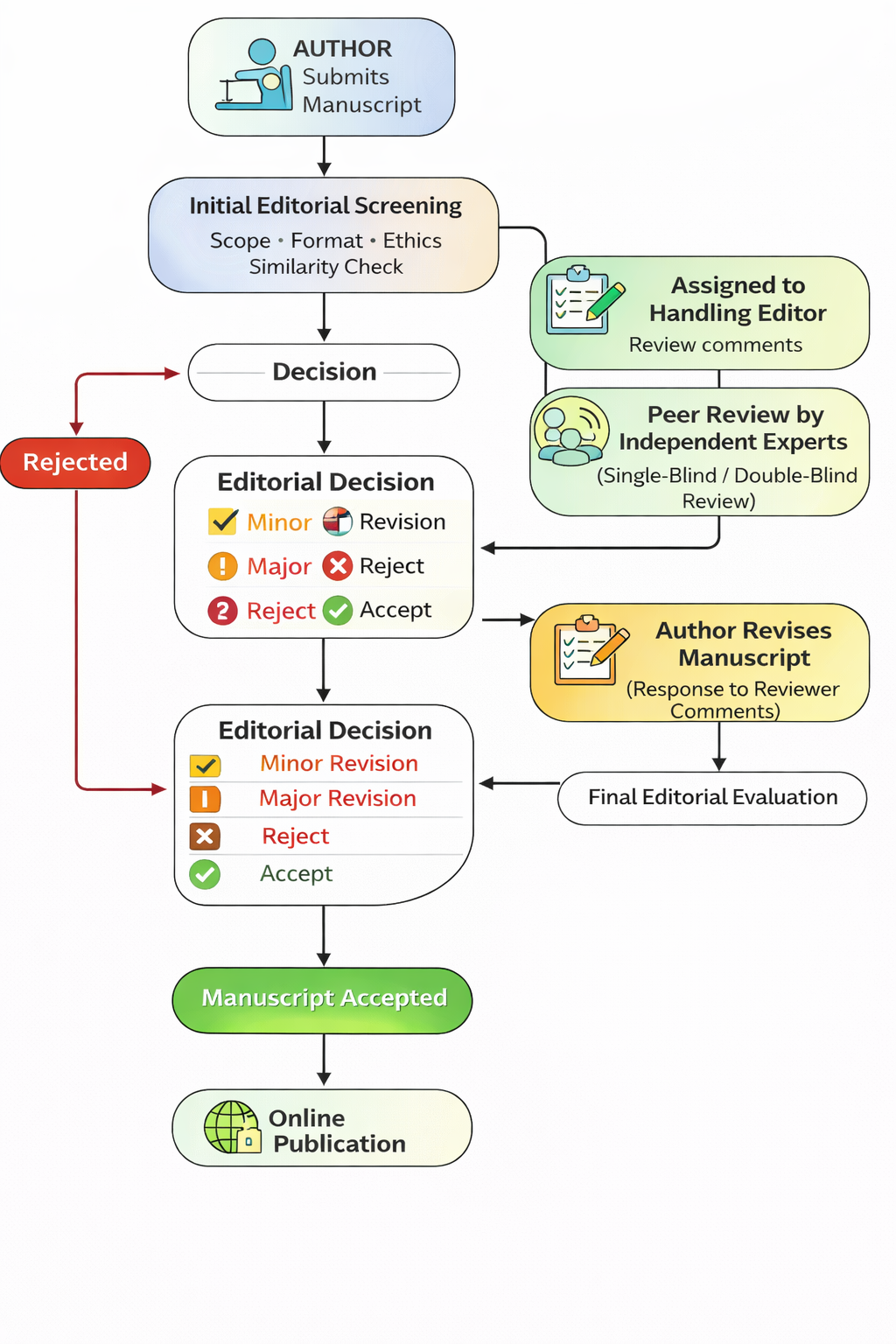
Space Science and Emerging Space Technologies adheres to a strict single-blind peer-review process to maintain the quality, integrity, and scientific validity of all published work.

Key features include:

  • Each manuscript is reviewed by at least two independent experts in the field, along with an academic editor.
  • Reviewers know who the authors are, but the authors remain unaware of the reviewer's identities.
  • The evaluations emphasize scientific merit, originality, methodological rigor, ethical compliance, and how well the work fits within the journal's scope.
  • Every submission goes through plagiarism checks and ethical compliance assessments before the review process begins.
  • The final decision on publication is based on the reviewer's recommendations and the editor's evaluation.

Publication Frequency & Format

This journal comes out Annual (One issue per year). Accepted articles are made available online in both HTML and PDF formats, ensuring that scholarly work is accessible and disseminated promptly.

Open Access Policy

Space Science and Emerging Space Technologies operates under a fully open access model. This means all published content is freely accessible to readers around the globe, without any subscription or paywall. Authors maintain the copyright to their work, and the content is shared under an appropriate open-access license.

Indexing & Archiving

Space Science and Emerging Space Technologies is dedicated to upholding high standards with the goal of being included in reputable scientific indexing and abstracting services. The journal also ensures long-term digital preservation through recognized archives and repositories, guaranteeing permanent access and discoverability.

Manuscript Submission

Authors are encouraged to submit their manuscripts through the journal's Online Submission System (Submit Manuscript) or by emailing them directly to the Editorial Office at support@researchpubx.com.

Manuscripts must adhere to the journal's author guidelines regarding structure, formatting, referencing style, ethical approvals, and necessary disclosures (such as conflicts of interest and funding).

Publication Ethics & Integrity

Space Science and Emerging Space Technologies follows internationally recognized standards for publication ethics and research integrity, which include (but are not limited to):

  • Make sure you have ethical approval.
  • Ensure informed consent and guarantee confidentiality.
  • Declare any conflicts of interest.
  • Be transparent about data availability.
  • Clarify authorship criteria and the roles of contributors.
  • Conduct anti-plagiarism checks.
  • Have a clear policy for retraction and correction.

Submit Your Manuscript

Submit your manuscript through our Online Submission System or send it as an e-mail attachment to the Editorial Office at support@researchpubx.com

Peer Review Process