About the Journal
Overview
The rapid advancement of science, technology, society, and global communication has transformed the way knowledge is created and shared across disciplines. Modern research increasingly moves beyond isolated academic boundaries, encouraging collaboration among diverse fields to solve complex scientific, technological, environmental, and social challenges. In this dynamic intellectual environment, interdisciplinary and multidisciplinary studies have become essential for generating innovative ideas, sustainable solutions, and globally relevant outcomes.
The Journal of Frontier Studies across Disciplines is established as an international open-access platform dedicated to promoting advanced scholarly research from a broad spectrum of academic and professional domains. The journal encourages integrative approaches that connect theoretical understanding with practical application while supporting collaboration among researchers, educators, scientists, industry experts, and policy practitioners worldwide.
The journal welcomes contributions from emerging and established areas of computer science and intelligent technologies, including artificial intelligence, machine learning, data analytics, computational intelligence, robotics, software systems, cloud computing, cybersecurity, blockchain technologies, human–computer interaction, Internet of Things, data engineering, natural language technologies, and quantum computing. Research exploring ethical computing, digital governance, responsible innovation, and the societal impact of intelligent systems is also strongly encouraged.
Engineering and applied technological sciences form another major focus area of the journal. Submissions are invited from fields such as electrical engineering, electronics and communication engineering, mechanical systems, civil and structural engineering, manufacturing technologies, industrial automation, renewable energy systems, transportation technologies, environmental engineering, and sustainable infrastructure development. The journal particularly values studies that integrate smart technologies, computational modeling, and real-world industrial applications.
The scope of the journal also strongly embraces life sciences, agricultural sciences, and plant-related studies. Relevant areas include botany, plant biotechnology, crop improvement, horticultural science, forestry, agricultural innovation, environmental biology, biodiversity conservation, ecological systems, and sustainable agricultural practices. Research addressing food sustainability, climate adaptation, ecosystem resilience, and natural resource management is highly encouraged as part of the journal’s broader commitment to global sustainability and environmental responsibility.
In health and biomedical sciences, the journal supports interdisciplinary research connected to healthcare technologies, biomedical engineering, medical informatics, telehealth systems, neuroscience, biotechnology, precision medicine, public health analytics, rehabilitation technologies, and digital healthcare innovation. Studies that combine medical sciences with engineering, computational methods, or data-driven healthcare solutions are particularly welcomed.
The journal additionally recognizes the growing importance of business, economics, management, and social innovation in contemporary research ecosystems. Contributions may include areas such as business intelligence, entrepreneurship, innovation management, digital finance, supply-chain analytics, organizational studies, strategic management, and information systems. Research exploring technology-driven transformation in business and society is considered highly relevant within the journal’s interdisciplinary framework.
Humanities and social science research also play an important role within the journal’s vision. Topics may include education, psychology, communication studies, digital humanities, ethics, cultural studies, public policy, computational social science, media studies, and human-centered research examining the interaction between technology, society, and culture. The journal encourages scholarly work that contributes to critical thinking, social understanding, and inclusive global development.
Environmental and earth-system sciences represent another key dimension of the journal’s scope. Areas such as climate science, geospatial technologies, environmental modeling, sustainability science, disaster management, urban systems, hydrology, earth observation, ecological informatics, and natural resource studies are welcomed. The journal aims to support research that contributes toward environmental resilience, sustainable development goals, and long-term ecological balance.
The Journal of Frontier Studies across Disciplines is committed to fostering high-quality scholarly communication through a transparent and rigorous peer-review process. Submitted manuscripts are evaluated by qualified reviewers and editorial specialists to ensure originality, scientific quality, methodological strength, and academic relevance. Publication decisions are based on the recommendations of independent reviewers together with editorial assessment.
As a globally accessible digital journal, the publication seeks to encourage the open exchange of ideas, accelerate scientific communication, and support collaborative research across international academic communities. By providing an inclusive platform for multidisciplinary scholarship, the journal aims to advance innovative thinking and promote meaningful contributions that address contemporary challenges across science, technology, health, environment, business, and society.
Aim and Scope
The Journal of Frontier Studies across Disciplines publishes original research articles, review papers, technical reports, short communications, conceptual analyses, and interdisciplinary studies that contribute to the advancement of knowledge across multiple academic and professional domains. The journal is dedicated to promoting innovative, integrative, and forward-looking research that connects science, technology, society, environment, health, law, humanities, and emerging global challenges through multidisciplinary and transdisciplinary perspectives.
Natural and Biological Sciences
The journal welcomes scholarly contributions in the natural and biological sciences, including biology, microbiology, genetics, biodiversity studies, botany, zoology, ecology, biotechnology, molecular sciences, chemistry, material sciences, nanotechnology, physics, geosciences, atmospheric sciences, and environmental systems. Research that advances scientific understanding, analytical methods, sustainable practices, and interdisciplinary applications within the life and natural sciences is strongly encouraged.
Engineering, Computing, and Technological Innovation
Submissions related to engineering, computing, and technological innovation are invited across a broad range of areas such as civil engineering, mechanical engineering, electrical and electronics engineering, industrial systems, artificial intelligence, machine learning, robotics, computer science, software systems, cybersecurity, cloud computing, data science, computational intelligence, Internet of Things, automation, smart technologies, and advanced digital infrastructures. The journal particularly values research that integrates technological innovation with scientific, industrial, or societal applications.
Environmental, Agricultural, and Sustainability Research
The journal further supports research in environmental sciences, agricultural systems, and sustainability studies, including sustainable agriculture, crop science, agro-technological innovation, forestry, biodiversity conservation, renewable energy systems, climate science, environmental sustainability, ecological resilience, water resource management, green technologies, and sustainable development strategies. Studies addressing environmental adaptation, ecosystem management, and global sustainability challenges are highly encouraged.
Medical, Health, and Biomedical Sciences
In the field of medical, health, and biomedical sciences, the journal publishes interdisciplinary research related to clinical studies, translational medicine, public health, epidemiology, biomedical engineering, healthcare technologies, medical imaging, neuroscience, rehabilitation science, biotechnology, health informatics, telemedicine, and AI-assisted healthcare systems. Research integrating medical sciences with engineering, computational methods, and digital innovation is particularly welcomed.
Social Sciences and Human Behavior
The journal also recognizes the importance of social sciences and human-centered research, including sociology, anthropology, psychology, cognitive science, behavioral studies, governance, political science, diplomacy, international relations, gender studies, social equity, public administration, policy development, and societal transformation. Contributions exploring the relationship between technology, culture, society, and human behavior are considered important within the journal’s interdisciplinary framework.
Law, Legal Studies, and Governance
Research in law, legal studies, and governance forms an integral part of the journal’s multidisciplinary vision. Relevant areas include constitutional law, international law, human rights, environmental law, cyber law, digital privacy, technology regulation, intellectual property rights, corporate law, financial regulation, criminal justice, criminology, legal informatics, judicial systems, public policy, and governance studies. Interdisciplinary legal research examining contemporary technological, environmental, social, and ethical challenges is strongly encouraged.
Business, Economics, and Management Studies
The journal additionally welcomes contributions from business, economics, finance, and management studies, including applied economics, entrepreneurship, innovation management, business analytics, financial systems, fintech, organizational behavior, leadership, strategic management, digital economies, marketing, communication systems, and corporate governance. Studies examining the impact of technological transformation and globalization on business and economic systems are especially encouraged.
Humanities, Arts, and Cultural Studies
In humanities, arts, and cultural studies, the journal supports scholarly work in literature, linguistics, philosophy, ethics, history, archaeology, cultural heritage, media studies, communication practices, visual arts, photography, music, design, and interdisciplinary cultural research. The journal values studies that examine the intersections between culture, creativity, technology, and society from both contemporary and historical perspectives.
Mathematics, Statistics, and Quantitative Sciences
The journal also publishes research in mathematics, statistics, and quantitative sciences, including pure and applied mathematics, probability theory, statistical analysis, predictive modeling, optimization methods, computational mathematics, quantitative analytics, and interdisciplinary mathematical applications across scientific and engineering domains.
Information, Library, and Knowledge Sciences
Contributions in information science, library science, and knowledge systems are welcomed in areas such as information management, digital libraries, archival science, data organization, metadata systems, scholarly communication, open science frameworks, knowledge integration systems, information retrieval, and digital research infrastructures that support global knowledge dissemination.
Architecture, Urban Systems, and Built Environment
Research related to architecture, urban systems, design innovation, and the built environment is also encouraged, including architecture, sustainable urban planning, smart cities, green infrastructure, environmental design, spatial analytics, geographic information systems, and technology-enabled built environments that contribute to sustainable and resilient communities.
Frontier and Multidisciplinary Research
The Journal of Frontier Studies across Disciplines particularly encourages frontier and multidisciplinary research that transcends conventional academic boundaries and integrates diverse areas of knowledge. Studies connecting science, engineering, medicine, law, humanities, business, environment, and social sciences to address global challenges related to sustainability, digital transformation, healthcare innovation, resilience, ethics, and societal development are highly valued.
Editorial and Peer-Review Policy
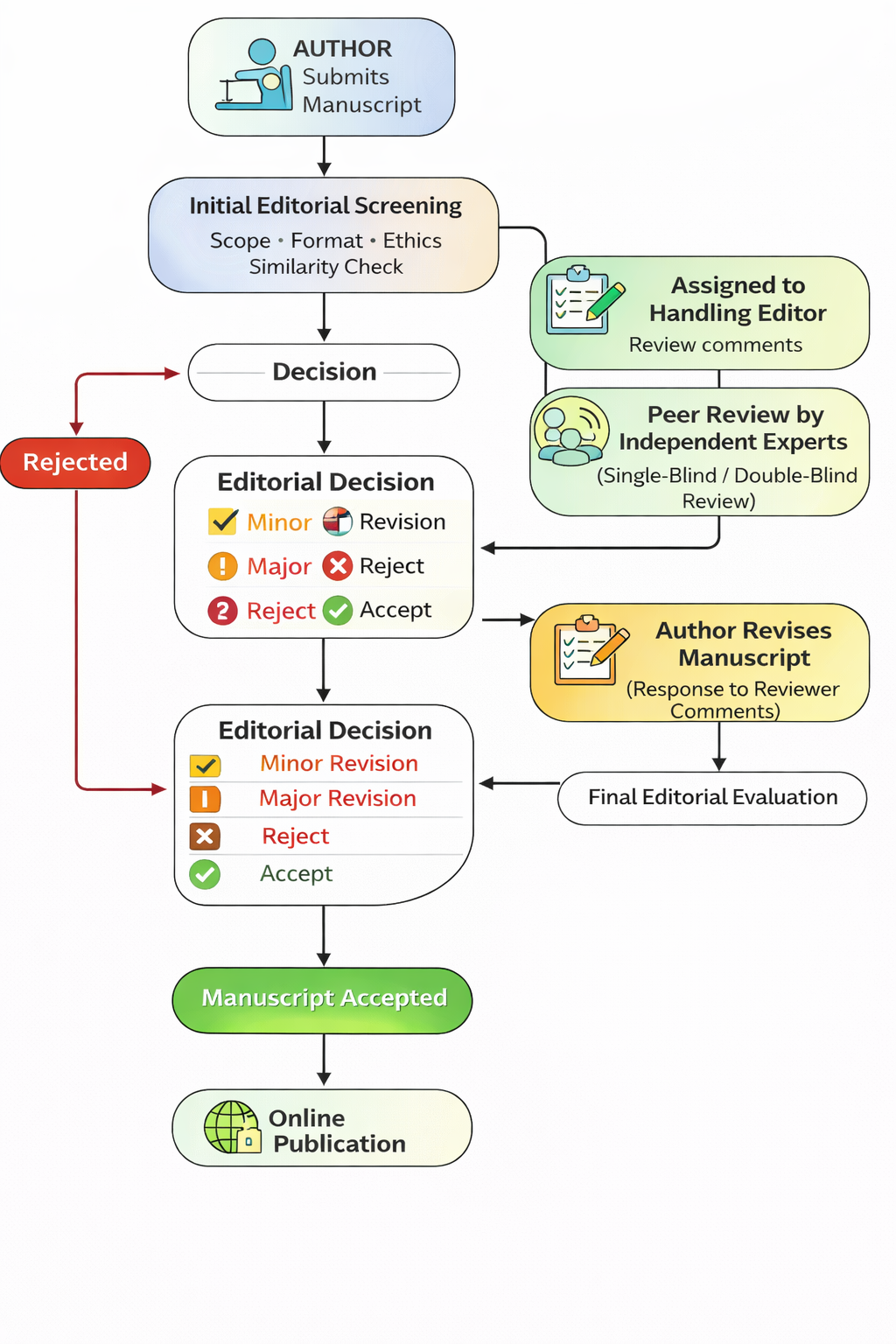
Journal of Frontier Studies across Disciplines adheres to a strict single-blind peer-review process to maintain the quality, integrity,
and scientific validity of all published work.
Key features include:
-
Each manuscript is reviewed by at least two independent experts in the field,
along with an academic editor.
-
Reviewers know who the authors are, but the authors remain unaware of the reviewer's
identities.
-
The evaluations emphasize scientific merit, originality, methodological rigor, ethical
compliance, and how well the work fits within the journal's scope.
-
Every submission goes through plagiarism checks and ethical compliance assessments
before the review process begins.
-
The final decision on publication is based on the reviewer's recommendations and the
editor's evaluation.
Publication Frequency & Format
This journal comes out Annual (One issue per year). Accepted articles are
made available online in both HTML and PDF formats, ensuring that scholarly work is accessible
and disseminated promptly.
Open Access Policy
Journal of Frontier Studies across Disciplines operates under a fully open access model. This means all published content is freely
accessible to readers around the globe, without any subscription or paywall. Authors maintain
the copyright to their work, and the content is shared under an appropriate open-access license.
Indexing & Archiving
Journal of Frontier Studies across Disciplines is dedicated to upholding high standards with the goal of being included in reputable
scientific indexing and abstracting services. The journal also ensures long-term digital
preservation through recognized archives and repositories, guaranteeing permanent access and
discoverability.
Manuscript Submission
Authors are encouraged to submit their manuscripts through the journal's Online Submission
System (Submit Manuscript) or by emailing them directly to the
Editorial Office at
support@researchpubx.com.
Manuscripts must adhere to the journal's author guidelines regarding structure, formatting,
referencing style, ethical approvals, and necessary disclosures (such as conflicts of interest
and funding).
Publication Ethics & Integrity
Journal of Frontier Studies across Disciplines follows internationally recognized standards for publication ethics and research integrity,
which include (but are not limited to):
- Make sure you have ethical approval.
- Ensure informed consent and guarantee confidentiality.
- Declare any conflicts of interest.
- Be transparent about data availability.
- Clarify authorship criteria and the roles of contributors.
- Conduct anti-plagiarism checks.
- Have a clear policy for retraction and correction.