
Environmental Resilience, Climate and Sustainability

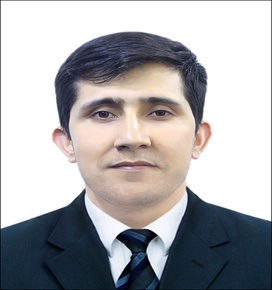
Dilshod Nematov (Ph.D)
Affiliation: SU Umarov Physical-Technical Institute of the National Academy of Sciencies of Tajikistan, Dushanbe
University / Institution: S.U. Umarov Physical-Technical Institute of the National Academy of Sciencies of Tajikistan
Department: Quantum Electronics Laboratory, Sector of Nanomaterials and Nanotechnologies
Designation: Head of the Quantum Electronics Laboratory
Country: Tajikistan
Dr. Dilshod Nematov is a materials scientist and Head of the Quantum Electronics Laboratory at the S. Umarov Physical-Technical Institute of the National Academy of Sciences of Tajikistan. He is currently also a Postdoctoral Researcher at Chongqing University of Posts and Telecommunications (China) under the National Young Foreign Talents Program.
His research focuses on computational materials science, integrating Density Functional Theory (DFT), molecular dynamics (MD), and artificial intelligence (AI)-driven approaches for the design and optimization of advanced functional materials for sustainable energy and environmental applications. His work spans photovoltaics, photocatalysis, thermoelectric materials, optoelectronics, photonics, hydrogen production, and environmentally friendly semiconductors.
Dr. Nematov has led and participated in numerous national and international research projects supported by organizations including the International Science and Technology Center (ISTC), Horizon 2020, the National Young Foreign Talents Program of China, and the National Academy of Sciences of Tajikistan. He has published extensively in high-impact international journals and actively serves as a reviewer for several SCI-indexed journals in materials science and condensed matter physics.
He is a TWAS Young Affiliate (2024–2029), Laureate of the International Youth Award "Commonwealth of Debuts" (2026), recipient of the Dushanbe Mayor's Prize in Natural and Technical Sciences (2023), and the Best Young Scientist of the CIS (2023). His current research aims to accelerate the discovery of sustainable materials through the integration of first-principles simulations, machine learning, and interdisciplinary collaboration, contributing to next-generation energy, environmental, and quantum technologies.