
Journal of Frontier Studies across Disciplines

ABSTRACT
Literature has become such a powerful medium in recent years that questions of race, identity, and transformation can be explored. Through an interesting narrative of white people waking up to find their skin dark, Mohsin Hamid’s The Last White Man brings out these issues and forces society to reflect on its entrenched ideas of privilege and belonging. Through a Critical Race Theory approach, the present study analyzes the novel for Hamid’s representation of racial identity and otherness with social change. The aim of the study is to analyses and interpret the major and minor themes that reflect the novel’s critique of racism and inequality. Through a qualitative approach and thematic analysis, the close reading of text shows the recurrence of images and excitement along with the tracing of ideas that show how race is socially constructed. The system of racial thinking that the Theory is about is the white life. The experience of whiteness at the level of the person was elusive and difficult to grasp. The racially intense, contradictory, and even human nature of the two clusters does not always suggest a racial epiphany in the end, either. However, the clusters in question cannot help but expose the instability of racial identity and its human cost. This paper ends with a conclusion stating that The Last White Man not only critiques pecking orders but imagines humanity otherwise. Combining thematic analysis with CRT, this study adds to literature to show how fiction can contest power and foster empathy and equality.
Keywords: Mohsin Hamid; The Last White Man; Critical Race Theory; Thematic Analysis; Race; Identity; Transformation; Social Inequality
INTRODUCTION
It is long known in literature how people and their societies are related. It portrays the actual world and also creates new concepts that provide the readers with an opportunity to observe the invisible laws of power, identity and prejudice that influence everyday lives. In Things Fall Apart by Achebe and Americanah, by Adichie, stories help authors to examine the ethics and politics of who we are, where we belong, and race [1,2].
According to Tyson, books allow readers to challenge conventional notions, cultural belief, and observe the invisible ways power operates that condition society [3]. In a world where there is increased migration, racial struggles and intermixed cultures, literature continues to make people comprehend how identity is contrived and how the groups that are privileged remain on top.
One of the most successful writers of our time, Mohsin Hamid is one who has managed to put much of the global worry into bare, but very philosophical stories. Hamid is born in Pakistan and educated in the United States, which is why his transnational background affects the way he views such problems as displacement, identity, and transformation. His novels such as Moth Smoke , The Reluctant Fundamentalist, How to Get Filthy Rich in Rising Asia, Exit West, and The Last White Man make up a consistent collection of work that examines the psychological and cultural ramifications of globalization. According to Nayar, and Ashcroft, Griffiths, and Tiffin, postcolonial authors like Hamid demonstrate that colonial hierarchies continue to exist in contemporary societies; however, it is not always imposed on them by obvious political domination but by some psychological or cultural influence [4,5]. In The Last White Man, Hamid takes this conversation into the landscape of race and develops a speculative project that destabilizes the concept of whiteness itself and brings out the precarious nature of racial categories.
The book opens with a literary depiction: "Anders, a white man, has woken up in the morning and he had become a deep and undeniable brown" [6]. The beginning of the disturbing assumption that is driving the story is a very simple yet very powerful line. What Hamid literally becomes is an inverted hunt after social fear, after the destruction of morals, as Anders and the rest of the members of his society are slowly turned into not white people anymore. What starts off as a physical transformation into a social crisis and it shows (or rather illustrates) how far in the privilege and belonging systems the concept of race is instilled. The fact that Anders is reeling to accept his new body is employed as a metaphor of the way society is grappling with the instability of the identity itself. As Kazmi, Javed, and Iqbal, call it, Hamid changes to speculative transformation becomes radical and causes the readers to consider the ideological premises that underlie the concept of racial power [7].
This assumption is highly compatible with the main principles of the Critical Race Theory (CRT), which is the main main theoretical foundation of this work. CRT has been developed by theorists such as Derrick Bell, Kimberle Crenshaw and Richard Delgado in the 1970s and asserts that racism is not a personal disease or a personal failure but a structural quality of social institutions [8]. It underlines that race is a social construct, which is perpetuated to strengthen inequality and uphold dominant structures. The interpretation of The Last White Man through the prism of CRT makes it possible to see how Hamid reveals the unreliability of racial identity and the fear of its disintegration. Crenshaw, says that identity operates at the place of personal experience and structural power, and Anders transformation is the reflection of this place [9]. Not only his altered skin color is a metaphor of his own alienation but also the hostility of the society to the loss of privileges and visibility to the established norms.
Although the previous novels of Hamid have received a considerable amount of criticism, The Last White Man is not the most explored. Research like Ashraf, Mehmood, and Naseem, and Masroor, Khalid, and Rajab, also explored its social and political aspects without providing a theoretical and thematic exploration on the basis of CRT [10,11]. This study covers that gap by doing a thorough thematic analysis of the major and minor themes in the novel. In the analysis, it is possible to distinguish between major themes, which are racism, transformation, and fear, and minor ones, including loss, guilt, violence, modernity, and nature. All the themes are examined within the context of the larger ideological framework of the novel and how Hamid manages to transform an abstract idea into a concrete emotional experience.
This artical is motivated by the fact that Hamid needs to be placed in the global discourse around race and privilege, rather than being relegated as a postcolonial or regional theory. Hamid, as Amir, Iqbal, and Arshad, observe, has always drawn the lines between the personal and the political in his fictional work, and the way identity is produced by the interplay of the culture and power systems that overlap [12]. There are however not many studies analyzing his depiction of race in the theoretical framework of CRTs. The Last White Man seems to be an allegory of racial transformation which goes beyond geographic lines in a period when global societies are struggling with migration, polarization, and demographic change. The novel encourages people to doubt the basis of privilege and also ponder about the human fear of otherness and change. This paper, thus, seeks to illustrate how the work of Hamid serves as an encapsulation as well as a group figuration of the re-formation of identity within a fast changing world.
The ongoing research is important because it is interdisciplinary in its contribution to the literary and racial discourse. First, it expands the range of CRT applications showing that its principles can be used to address non-Western texts and contexts. As Delgado and Stefancic, note, CRT leads to the creation of the counter-narrative, which can provoke the key challenges to the dominant belief regarding race and privilege [8]. This antifeminist desire to overturn the myth of whiteness as fixed identity and replace it with fluid and contingent identity, is reflected in Hamid novel. Second, this study has a methodological contribution, that is, it employs the thematic analysis as a systematic means of identifying the meaning patterns in literature. According to Braun and Clarke, thematic analysis is a versatile system that allows the investigator to transition between defining and interpreting the data and determining the interaction of the personal feelings and shared values [13]. When implementing this strategy, the paper aims to demonstrate how the simplicity of Hamid words hides a complex commentary on the contemporary racial consciousness.
The other motivation behind doing this research is the critical research gap in the literature on the intersection of race and postcolonial identity in the modern South Asian literature. The thematic investigation used by Deshamukh, to study The Old Man and the Sea and Yaya and Sayra to explore The Young Crusader can reveal the practicality of the thematic inquiry in revealing moral and philosophical dimensions [14,15]. Nevertheless, little work continues to apply such analysis to the contemporary South Asian fiction on the framework of CRT. This paper bridges the gap, by both offering thematic richness and offering theoretical acumen, showing how the Hamid story is a part of a greater comprehension of how literature can deal with race as a concept as well as a lived experience.
There are three major questions which guide the paper. In what way does The Last White Man by Mohsin Hamid reflect the problem of racial identity, social change, and personal transformation? Which are the key and secondary themes that guide the process of how the novel explores the question of race and belonging? How does the story by Hamid confirm or even dismantle the tenets of Critical Race Theory, especially when it comes to whiteness, hierarchy, and marginalization? The study has three objectives in order to answer these questions. The initial one is to determine and examine the major and minor themes that form the ideological and emotional dimension of the novel. The second one is to explore how Hamid reinvents the concept of race and identity by means of transformation and resistance. The third is to find out how the fundamental ideas of CRT (whiteness critique and the application of counter-narratives) are integrated into the narration by Hamid and how it is employed to its subruptive effect.
CRT and thematic analysis are used hand in hand. CRT offers theoretical perspective in which the racial politics of the novel may be viewed and thematic analysis gives the methodological provisions to the way to organize and analyze the textual meaning. The synthesis is essential to provide the depth and coherence to the study which is capable of linking the textual interpretation to the socio-political critique. According to Vaismoradi, thematic analysis is especially useful in finding implicit meanings in complex stories and, therefore, it is highly applicable to the allegorical narration of Hamid, in which the apparent simplicity of the story hides profound philosophical ideas.
In addition to the analytical value of the study, it has more comprehensive implications to cultural studies and pedagogy of literature. Through the way in which The Last White Man disrupts dichotomous ideas about race, it aids in continuing to decolonize literary language and increase theoretical approaches beyond Western paradigms. Baldick, helps to remember the fact that the power of literature is not only its aesthetic power, but its ability to challenge moral assumptions [16]. This power is reflected in the work by Hamid who attempts to imagine a world where race as a category melts away and asks the readers to reflect on their own roles as participants in the regime of exclusion and privilege.
The remaining part of the paper is divided in the following way. The section two gives the related works, including a review of the prior scholarship on Mohsin Hamid fiction and the gap in research that the study will focus on. Section three substantiates the theoretical framework of the Critical Race Theory, summarizing the main principles of the theory and its role in the analysis of race and identity in The Last White Man with respect to studies; Section four explains the research methodology, which will be an analysis of the qualitative design, data collection process, analytical procedure, and ethical considerations in conducting this study. In section five, the findings and interpretation of the theme are discussed and both the main and secondary themes are considered to demonstrate how the novel by Hamid addresses the social, emotional, and ideological aspects of racial change. Lastly, Section six makes a concluding statement of the paper, summarizing the main observations and conclusions of the research and provides recommendations to other scholars who may want to develop this paper further.
Related works
Literature has also been a way of cognizing how people and communities bargain the issues of race, identity, and change. The fiction of Mohsin Hamid, especially The Reluctant Fundamentalist and Exit West has been the focus of a lot of interest due to its exploration of the topic of globalization, belonging, and postcolonial identity. His most recent book, however, is the novel The Last White Man which has not been discussed properly. Although its dramatic premise and moral dramatic intensity have been recognized by critics, little thematic analysis has been done on a detailed, theory-based approach. In this section, the literature on the work of Hamid and other sources that are relevant to the study is examined to identify the gaps that need to be bridged in this paper.
However, Ali and Khadim, provide a postcolonial reading of Mohsin Hamid’s The Last White Man, focusing on racism, otherness, and identity crisis within the novel [7]. Using a qualitative descriptive-analytical approach and drawing on postcolonial scholars such as Homi K. Bhabha, Frantz Fanon, Edward Said, and Leela Gandhi, they examine how racial transformation affects the identities and relationships of Ander, Oona, and other characters. Their analysis demonstrates that Hamid challenges fixed racial and cultural distinctions by portraying the consequences of Ander’s transformation and the reactions of those around him. The study also emphasizes the novel’s engagement with questions of identity, racial difference, and the social construction of otherness. However, its primary emphasis is on postcolonial concepts of racism, otherness, and identity rather than on systematically identifying and categorizing the major and minor themes that develop across the narrative. This leaves room for the present study to provide a more systematic, theme-based examination of The Last White Man, identifying, classifying, and interpreting its central and subsidiary themes through a clearly defined theoretical framework.
The same weakness can be seen in the work by Perveen, who interpret The Last White Man metaphorically and literally. They use parallels to draw an analogy between the physical transformation of Anders and the metamorphosis of Gregor Samsa in the novella of Kafka and write about the alienation, isolation, and psychological discomfort. Their writing points out that Hamid has used the magical realism to show the fear of racial and existential displacement. Even though their approach to interpretation is insightful and emotionally charged, it is symbolic, not structural. The theme strands that prevail in the meaning of the novel and the relationship between ideas are not clear in the study. It is based on their observations that this study aims to take these observations a step further, tracing the thematic structure of the novel in a more detailed way, categorizing the repeats in a wider theoretical scope.
Another worthy contribution was made by Ashraf, Mehmood, and Naseem, who discuss The Last White Man in the framework of the postmodern theory of metanarratives and micronarratives developed by Jean-Francois Lyotard [10]. They observe that the novel by Hamid itself subverts racial ideologies as it brings out race as a social construct and a volatile category, instead of a biological fact. According to their analysis, the novel displays a number of postmodern features, including fragmentation, multiculturalism, and distrust of grand narrative, which includes racial purity. Their philosophical reading is very insightful, but is abstract and not organized into thematic organization. The present study adds to their contribution because it bases the discussion on Critical Race Theory that enables exploring the issue of race and power in the novel by Hamid in a more specific way.
Masroor, Khalid, and Rajab approach The Last White Man through Critical Race Theory and highlight how the novel could challenge the primary White racial discourses and create counter-narratives to destabilize the whiteness [11]. They maintain that Hamid redefines the concept of racial identity by how Anders transforms and uses it as a metaphor to social change and opposing structural privilege. Their discussion succeeds in connecting the concepts of CRT like racializing, white normativity, and counter-storytelling to the narrative form of the novel. Nevertheless, they are primarily concerned with the ideological aspects, neglecting the fact that the range of emotions that affect the emotional depth of the novel includes fear, love, grief, and family. Their contribution has been extended in the present research by combining CRT with thematic analysis to give both ideological and structural understanding.
Another variant of interpretation is presented by Guy Gunaratne, who in his literary review in The Guardian wrote that The Last White Man is a hypnotic race fable that examines the weakness of whiteness and the heart of transformation [17]. Gunaratne draw parallels between the work of Hamid and that of Kafka in his Metamorphosis or Saramago in his stream-of-consciousness prose, and how the novel is able to reflect tension in the society as well as the emotional nuances (intimate). His criticism values Hamid in his skill to portray the issue of grief and loss using tiny words but it also notes that the world is not well-built in the novel. His review is interesting, but it is not analytical and theoretical. Such observations are enhanced in the current research study where theory is used to further elaborate the treatment of race and identity in the novel.
This paper is also put into context using thematic studies of other literature works. The Old Man and the Sea by Hemingway is a thematic analysis of the literary work by Deshamukh, who discusses the themes of perseverance, dignity, and endurance of a man [14]. The analysis deciphers the struggle of Santiago as the symbol of individual success in spite of material loss but was still held in the traditional moral themes. Yaya and Sayra, discuss The Young Crusader by Solomon Hailemariam, highlighting that the theme of justice, love, and the honesty portrayed in the song are the main symbols of the resistance in Ethiopia against corruption. Likewise, Ekpong, examines the fiction of Ama Ata Aidoo in which female characters engage in the transformation process of passivity to independence in terms of friendship and emotional development [15,18]. Although these works illustrate the variety of thematic analysis, they pay little attention to the Critical Race Theory or emphasize on the race as a social construct. This paper builds on the thematic analysis by using CRT in the novel by Hamid thereby describing the racial aspects that have been ignored in other literature.
The readings and reviews in different publications further shed light on how the reader and critics interpret the The Last White Man, with Gunaratne, in the Washington Post, defining the story as a hypnotic fable about the deconstruction of whiteness, and Charles, as an expression of modern-day racial apprehension [17,19]. In his Frontline, Menon, asks the question of whether Hamid is too speculative of emotional realism. Wired, admires the moral ambition of the novel, but complains that it does not feature much voices of non-whites [20,21]. The Christian Science Monitor, and The Spectator, also enjoy its allegorical purpose, though they observe that the historical complexity is not as rich [22,23]. Locating the novel in the post-9/11 course of Hamid, the Hindu, dwells on the novel theme of social reversal, family breakage [24]. These reviews draw our attention to the depth of Hamid style and moral imagination but are descriptive and not very theoretical. This paper expounds on their ideas by bringing CRT to examine how the novel dismantles and reconstructs race both metaphorically and in actual sense.
The variety of scholarly and critical interest still does not cover the research gap. Little of the thematic analysis, but thematic analysis combined with CRT, has been undertaken to study how Hamid uses his tale to simultaneously challenge racial stratifications and portray new models of identity. To fill this gap, the current analysis is aimed at discussing the significant and minor themes in the novel within theoretical context, which links the meaning of the text and social critique. In this way, it will combine the interpretive and political aspects of Hamid in that The Last White Man will become an important work of literature in the global discourse of race, privilege, and belonging.
THEORETICAL FRAMEWORK
The present study relies on Critical Race Theory (CRT) as its major analytical tool. CRT became the work of a group of legal studies scholars, including Derrick Bell, Kimberle Crenshaw, and Richard Delgado, in opposition to the drawbacks of traditional methods in civil rights movements. It dispels the notion that racism is an individual issue where the authors argue that it is a natural, institutional mechanism in social institutions [8]. CRT makes it clear that race is not a biological reality, but a social construct which is upheld by political and cultural processes that further the interest of the dominant groups.
CRT being one of the major principles, it is centered on the social construction of race and the concept of white normativity, which denotes the idea of whiteness as an unmarked and privileged social norm. Counter-narratives are also valued in the theory and enable marginalized voices to disrupt prominent ideologies and reorient the ways of discussing race. CRT has been used to provide critical instruments to the study of the replication and challenge of racial hierarchies in stories, the ways characters reflect or challenge systemic inequalities in literary work.
Using CRT to The Last White Man it is possible to see the story Hamid tells not as the tale of physical changes. The novel relies on the transformation of the color of the skin of Anders as a metaphor of the unsteadiness of racial categories and the fear of losing the advantage of social positioning. Hamid demonstrates the emotional and moral impacts of racism at the individual and societal scales by presenting the whiteness as delicate and manufactured. His sparse prose style and allegorical style serves as a counter-narrative to the prevailing racial ideologies and makes the readers reconsider their understanding of identity, belonging, and empathy.
This theoretical methodology fits well with thematic analysis that finds and analyzes repetitive concepts in the text. CRT grants the critical lens whereas thematic analysis grants the structural method. Collectively, they enable one to make a dual reading of The Last White Man, a critical and an interpretive reading. It is the complex of these structures that enables one to follow how Hamid brings the everyday experiences of fear, grief, and love to a bigger register of reflection on race and humanity. Through this synthesis, the research can see that literature is not just a description of the state of race, but a component in recreating its meaning.
MATERIALS AND METHODS
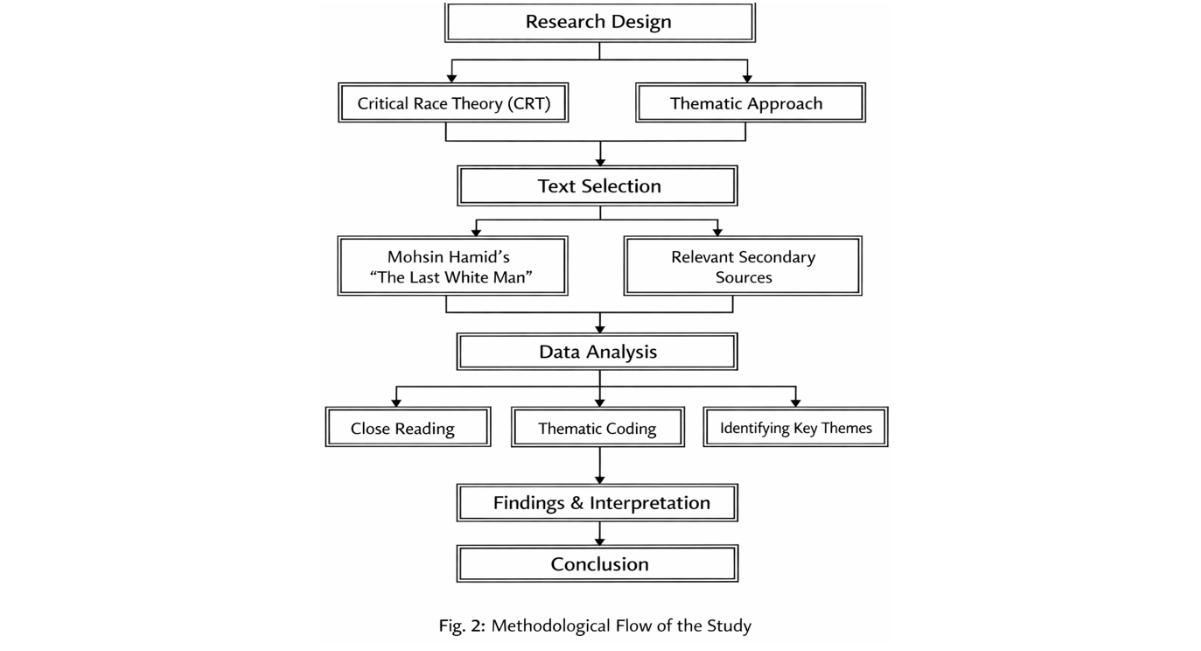
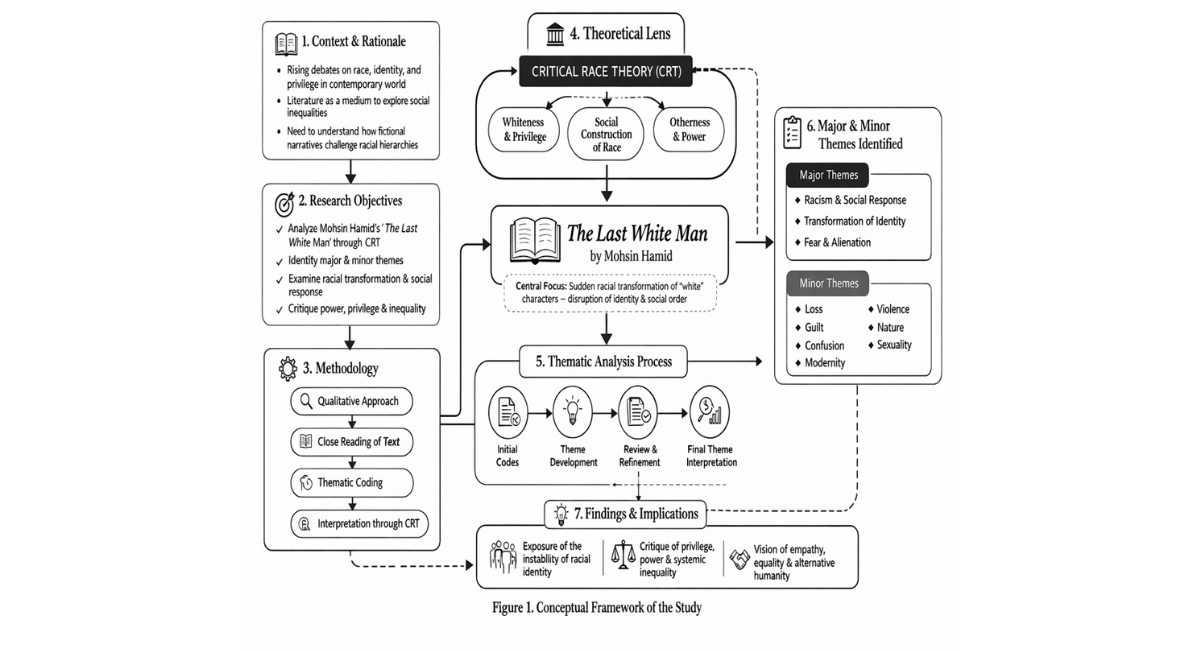
This paper uses a qualitative research approach aimed at discussing the ways in which The Last White Man by Mohsin Hamid embodies the concepts of race, identity and change. This section aims at describing the methods and procedures that informed the analysis such as the research design, data collection process, data analysis method and theoretical background. The objectives are to make the findings of the study credible as well as based on systematic interpretation framework.
The qualitative research design was chosen since the purpose of this paper is not to measure or quantify the information but to make sense and interpret meanings and ideas of the text. Literature especially fiction encourages various reading and subjective interaction. Hence, a qualitative design offers the required layers and flexibility to reveal the construction of such themes as race, belonging, and social transformation in the story by Hamid. Since the research is based on interpretation, and not numerical generalization, such a design makes it possible to investigate both the language and ideology in a subtle way. By qualitatively examining the work The Last White Man, the research will attempt to highlight how The Last White Man exemplifies the general cultural fears of racial identity and social transformation, as well as challenges the presuppositions on which they are based.
The main source of the study is a novel The Last White Man by Mohsin Hamid [6]. The text itself provides the focus of analysis and makes thematic interpretation. Close reading is a common form of literary research and the researcher completed this approach to determine passages, dialogues and descriptions that demonstrate the key issues of the novel. Several readings were conducted with an aim of capturing the recurrent motifs and symbols related to race, fear, identity and transformation. Beside the main text, secondary sources, such as journal articles, books, essays, and interviews were also used to place the discussion in the context of more general critical discussions of Hamid work and Critical Race Theory. These sources gave the required scholarly background and made sure that the analysis will not be held out of context but will be based on the prevailing scholarly discussions.
The analysis of the data is based on the model of thematic analysis proposed by Braun and Clarke, which consists of identifying, structuring, and interpreting meaning patterns of a data set [11]. The reason behind the selection of this method is that it facilitates the researcher to identify explicit and implicit themes, which are brought out in the narrative. This started by thoroughly reading and familiarizing with the novel so as to get a profound insight into the form, characters and even the symbolic levels of the novel. Key words, phrases and events that were related to race, identity, transformation as well as social fear were then given the initial codes. These codes were arranged and developed into more general themes that embody the ideological and emotional structure of the text. Thematic analysis was therefore the practical means of determining the way to meaning construction in the work of Hamid and the Critical Race Theory the means through which such meanings were analyzed.
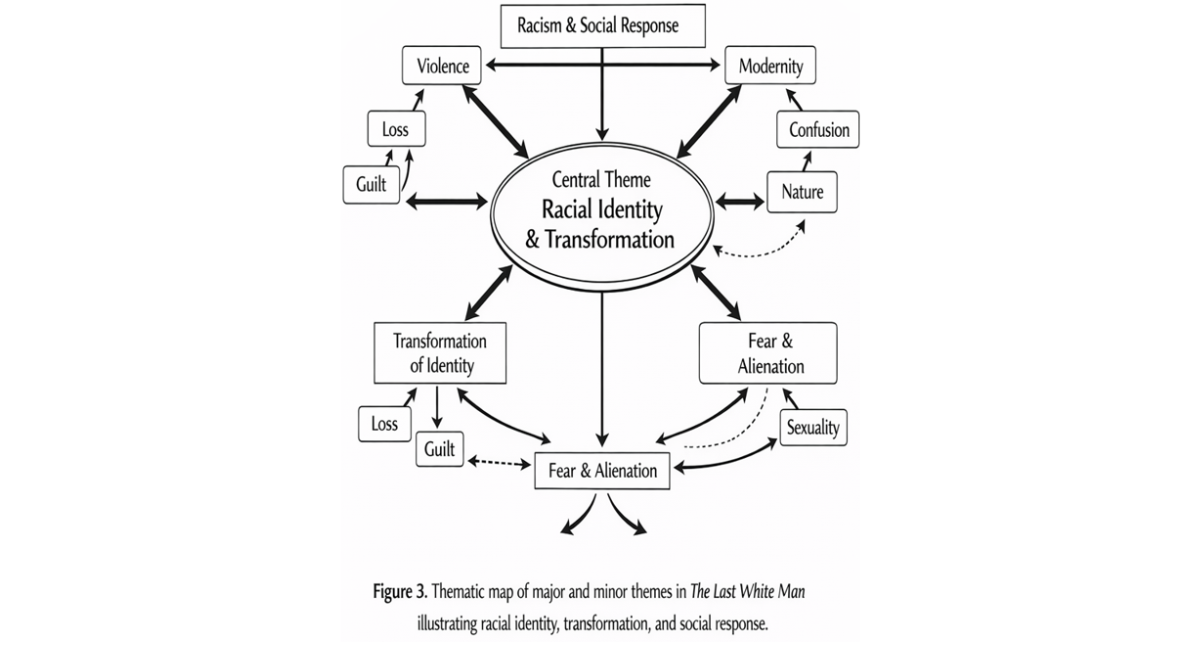
The identification and organization of themes followed a structured, multi-stage coding process. During the initial reading, the researcher generated open codes for recurring words, images, and narrative moments connected to race, embodiment, fear, and belonging, including descriptions of Anders's changing skin, the reactions of his community, and the broader moments of social unrest that unfold across the novel. These open codes were then grouped into candidate categories based on their conceptual similarity. For example, codes relating to bodily change and self-alienation were merged under the category of transformation, while codes relating to community hostility and social breakdown were merged under the category of fear. These categories were then reviewed according to how frequently they appeared in the text and how much narrative weight they carried. Themes that recurred consistently throughout the novel and carried significant plot or ideological importance, namely racism, transformation, and fear, were classified as major themes. Themes that appeared more intermittently or played a supporting role, such as loss, guilt, violence, modernity, and nature, were classified as minor themes. This classification was not arbitrary. It was based on the amount of textual evidence available for each theme, the centrality of the theme to the novel's broader ideological argument, and its direct relevance to the core tenets of Critical Race Theory. Finally, the complete set of themes was cross-checked against the research questions to ensure that each one meaningfully contributed to answering how the novel represents racial identity, transformation, and resistance.
The overall framework of the study is the Critical Race Theory (CRT) as it connects the textual results with the socio-cultural criticism. CRT is especially applicable since it considers the role of race as a normalized aspect of the society and not as a personal form of prejudice [8]. Through the combination of CRT and thematic analysis, the study was in a position to discover how the novel Hamid deconstructs the racial categories, reveals systemic privilege, and reinvents the human relationship outside the racial categories. This philosophical strategy allowed explaining the transformation of Anders, not only as a personal one but as an allegory of the instability of racial identity in a globalized, postcolonial world.
The ethical consideration is another problem that was reported to be present during the research process. Although there is no human participant in the research, the study maintains academic integrity, as it is adequate in terms of valuing intellectual property and adhering to citation styles. All the sources (both primary and secondary) are referenced in the APA (7th edition) style. It was essential that the researcher was adherent to justice and accuracy in interpretation making sure that the text of Hamid and the theoretical materials were presented as they are and not distorted. Their moral strictness also entailed sensitivity to problems of race and identity, with no reductionist or stereotypical explanations of culturally complicated text.
Although the selected methodology offers a powerful approach to the analysis of The Last White Man , there are some limitations that should be admitted. The analysis is based solely on the text and does not reach out to the reader-response attitudes or other authors and texts comparison. Also, thematic analysis enables one to look intensively into the internal logic of the narrative, but it fails to consider the wider empirical social data. All these constraints do not make the research invalid but instead explain its nature in that the novel is intended to be a comprehensive literary and theoretical explanation of Hamid, but not a sociological one of race or identity.
RESULTS AND DISCUSSIONS
This part of the paper contains a close reading of the result of the thematic analysis of the novel The Last White Man by Mohsin Hamid in the prism of the Critical Race Theory (CRT). According to the methodology, the analysis was done by closely reading the text to determine patterns, emotions, and other symbolic moments of how race, identity, and social change are constructed and experienced in the narrative. The results are systematized based on the major and minor themes that were formed due to this process. In the novel, the central exploration of human behavior and racism focuses on the major themes, including racism and social response, transformation, as well as fear and alienation. The small motifs (loss, guilt, confusion, modernity, violence, nature, and sex) make the themes emotional and philosophical, showing the complexity of the experience of individual and collective life. Through these themes read in the context of Critical Race Theory, this section indicates how the novel by Hamid reveals the social order that perpetuates the racial hierarchies and offers the personal conflicts that emerge when the order starts to break. The discussion is based on the same methodological approach discussed in the previous part and shifts to the critical interpretation of the text to demonstrate how The Last White Man employs fiction to challenge the issue of race, privilege, and transformation in the contemporary world.
Analysis of Major Themes
Racism and Social Response
The main theme in The Last White Man by Mohsin Hamid is racism and how society reacts to the change of race. The novel starts with a weird phenomenon in which white individuals are found to have changed in to dark and in this way Hamid illustrates how much raciality influences people lives, thinking and how they associate with each other. This turnaround leads to the realization of fear, discomfort and hostility underlying the fabric of every society. When the people start to transform, their communities are not supportive or sympathetic. Rather, there is confusion to outright rejection that displays how the racial identity is constructed socially and is strongly connected with a sense of value, safety, and belonging.
These scenes, taken together, point to something Critical Race Theory has long argued: that racism is rarely a matter of isolated cruelty carried out by a single villain. It tends instead to live inside the ordinary structures of daily life, in offhand remarks, in silences, in the small habits people fall back into without thinking. The boss's careless comment, the neighbor's suicide, the sudden coldness at the gym, even the unease inside Anders's own family, none of these moments involve someone deliberately setting out to harm another person. Yet together they show how thoroughly racial hierarchy has settled into everyday social life, and how quickly it resurfaces the moment whiteness can no longer be taken for granted. In this way, Hamid is not simply telling a story about prejudice. He is showing race functioning as a kind of invisible architecture, one that quietly decides who is safe, who belongs, and whose life is treated as worth protecting.
Early in the novel, Anders faces a deeply unsettling reaction from his boss after returning to work. “To his boss Anders explained his situation, which was not unique, nor contagious, as far as anyone knew, and returned to the gym after a week off (...) his boss looked him over and said, ‘I would have killed myself.’” [6]. When Anders does not respond, his boss adds, “if it was me.” [6]. These lines show how whiteness is seen as the norm and how losing it is treated almost like a tragedy.
The response of the boss shows how strongly white people are socially valued, so losing white skin appears to be intolerable. This demonstrates the racial identity as it is linked to social value and how individuals easily expose inner racial prejudice despite using informal dialogues. The silence of Anders is revealing something as well. He does not argue or react violently, which is possible to show his confusion, fear, or even shame. Delgado and Stefancic, note that Critical Race Theory allows observing that racism is not necessarily loud and violent; it is often ingrained in everyday thinking and behavior [8]. In this brief yet effective scene, Hamid demonstrates that race defines the way different people perceive themselves and other people, particularly when those classifications start to change.
The other important illustration is where a man in the town that Anders lives in shoots himself after undergoing the same transformation. The text states, “Anders’ boss had said he would have killed himself and following week a man in town did just that, and his story followed by Anders in the local press..., this man shooting himself in front of his own house, a shooting heard but not seen by neighbours and called in, and assumed to be an act of home defence (...) and the sum of all it was clear in other words the dark man and the white man were the same.” [6].
It is this point which reveals the psychological pressure at its extreme due to racial transformation. The confusion and fear of the new race identity is brought out through the suicide of the man, which was confused as a crime or a self-defense measure. It demonstrates also how the system favors denial or violence instead of embracing change.
The social environment turns stressful and awkward as the number of changeable individuals increases. This is reflected in even such ordinary places as the gym. Hamid writes, "I Anders had thought this would make things better but it seemed the opposite was happening and gym was increasingly tense, and men who had known each other for years now acted like they did not know each other or worse dislike each other, bore grudges, and the violence of heavy lift, within that violence.” [6].
This textual evidence is an example of the impact of race on social relationships. Friendships are ruined and individuals do not view each other in the same light. The gym which is a place of habit and friendship is turned into a symbol of the increasing mistrust and violence. Hamid relates this tension to racial change, demonstrating how the fear of difference can destroy the social cohesion.
At the personal level, racism is also practiced in families. Her mother is severe when the changes in Oona start to appear on her color. The narrator notes, “Oona’s mother was startled and then stony in response, saying you should be ashamed of yourself.” [6]. Oona is judged instead of being comforted or concerned. This response demonstrates how much intimate relationships can be affected by internalized racism. The shame of her mother is an expression of the extreme connection between the society and whiteness and value. Hamid takes this instance to emphasize the point that racism is not only external but it is also mostly internalized in the home and is transmitted across generations.
The love and relationships are also influenced by racial change. Even when Anders kisses Oona, his father experiences a discomfort though he realizes that Anders is the same person. The narrative explains, “Anders saw the discomfort on his father’s face, the discomfort at seeing this white girl (Oona) kiss the dark man even though the dark man was not the dark man, even though the dark man was Anders.” [6]. This sentence is very strong as it demonstrates how the outward appearance may take precedence over identity in the eyes of the osee beyond color of his skin. This uneasiness is not regarding the relation itself but rather the race that it takes into account how racism works without utterances but through the unconsciousness and bias. His father finds it hard to, even though nothing has changed in the personality of Anders.
All in all, The Last White Man takes advantage of these scenes to explore the degree to which the society relies on racism. The novel asks the readers to perceive the fact that race is not a biological fact, but a social construct that has practical implications. Hamid demonstrates how social structures are fragile and easy to breakdown in the face of difference by looking at the reactions people have at the time of racial identity alteration.
Transformation
One of the most significant themes in The Last White Man is transformation, and it starts with the very first page. Sudden and unexplained transformation of the skin color of Anders effected by Mohsin Hamid is used as a metaphor of deeper identity, perception and social transformation. It is not a mere physical change but also an emotional and psychological one. It questions the way individuals perceive themselves and other persons as well. In the case of Anders, to wake up with dark skin is the first step of a personal and social experience of fear, awkwardness and gradual adjustment.
The novel begins with a sensational scene:: “One morning Anders, a white man, woke up to find he had turned a deep and undeniable brown... that there was somebody else with him.” [6]. This is both physical and emotional change. It is not merely transforming the visual appearance of Anders, it transforms his identity. He is no more himself. This comes out vividly when he does not want to see people after the transformation: “He had not yet seen anyone since he had changed… but he was out of milk and chicken breast(…) and he had to go out and face the world.” [6]. He is attempting to hide his face with a cap, which demonstrates that he is not comfortable and is afraid to be judged. These reactions at an early age explain the degree to which identity is associated with appearance and the reaction of the society when the appearance ceases to match societal standards.
The reaction of the people, or a reaction that Anders expects, is an important aspect within the initial phases of the novel. People do not mistreat him outright but Anders thinks that they are hostile in their actions: “He did not know what they were thinking(…)he saw flickers of hostility or distaste… the clerk did not recognize him.” [6]. His fear is not always founded in the real violence but on his lifetime learning of how people respond to those that are different. Such perceived antagonism is indicative of the extent to which the social prejudice has become entrenched in the psychology of individuals. Moreover, the concept of being unrecognized by a person who was able to know him previously is strong. It indicates the degree to which race influences our sense of identity even greater than names or even voices. The emotional uneasiness that Anders experiences is reflected in the response of Oona: “She was taken aback, not merely because he was darker, but because he was no longer recognizably himself.” [6]. Her response is not a hate one, but rather an eye opener, in that even people close to her have a hard time accepting the Anders that they once knew and the Anders that they now see. Here, the point that Hamid is making is that identity, in the eyes of the other people is often constrained by the visual. Race tells us, looking past the individual, before we see him.
The more individuals start experiencing the same transformation, the greater the overall unease. The changes do not appear to unite people but on the contrary, they appear to widen the existing divisions. “There were dark hosts mixed with white hosts, and they were awkward with each other and unnatural.” [6]. This clumsiness depicts the fact that the society has not been used to racial equality where it is not imposed by the hierarchy. There is no clue on how to behave when the racial order is broken by the hosts, as well as by the general population. This reflects the actual real-life racial tension in which even integration may seem to be a show or an imposition without actual understanding between the two parties. The misjudgment of identity is further brought out as Anders listens to a voice and is aghast to find out that the man is dark: “The man who sounded white turned out to be dark, and Anders thought who knows, maybe he thinks the same about me.” [6]. This scene demonstrates that change not only changes the looks but also dismantles the antiquated beliefs that people have constructed in terms of race, voice and conduct. The town itself even starts to be strange to Anders. “Anders noticed how many dark faces were there, and the town was different (…) a different place, a different country.” [6]. The racial shift carries the perception of the place he first knew as home, with which racial identity is closely linked to a feeling of national belonging.
The theme of transformation does not only apply to Anders but also to Oona, who is the one who takes it very personal. Her experience of change when it happens to her results in a drastic emotional and psychological dislocation. “Oona went to the mirror and saw a stranger… this dark woman who was recently a stranger and who was Oona.” [6]. This is the time when we are unable to realize how much we are disoriented by the absence of a consistent visual identity. Her self-image does not correspond to her inner self anymore and resolving such a conflict will be a painful task. She can hardly endure the transformation due to the reaction of people around her. Her mother’s reaction, “You should be ashamed of yourself.” [6], unveils the generation and social prejudices, which have been internalized. Oona is not offered support, but rather shame, which serves to strengthen the fact that transformation is seen as a degradation, in this case. In the same vein, the father of Anders finds it hard to accept his son with his new look, not to mention his aversion when he sees his son and Oona express their love to one another: “The discomfort at seeing this white girl kiss the dark man even though the dark man was not the dark man, even though the dark man was Anders.” [6]. The scene says so much about the extent to which race plays into perception, even when the individual is identical. The aesthetic change is uncomfortable and oppositionary. Through this, Hamid reveals that change is not only a personal experience but one that reveals the group of discomfort which the society has towards racial difference.
Fear and Alienation
One of the most prevalent responses that appear in The Last White Man is fear especially when characters start to change racially. It is not only the change of the skin color which causes such fear but the social results that cannot be predicted. At the moment when Anders realizes that he changed, he locks himself out of the world in fear of the reaction of others. “He had not yet seen anyone since he had changed(...)but he was out of milk and chicken breast... and had to go out and face the world.” [6]. There is a serious anxiety in his indecision. It is not the violence he is afraid of, but the fact that he will lose recognition, belonging and be perceived as the same person. The intimidation of being looked at differently starts to define his actions whereby he wears a cap covering his face and does not want to be near anyone. This is the way in which fear quietly changes the identity of a person and his/her feeling of security even within the most ordinary routines.
Seen through this same theoretical lens, the fear running through the novel starts to look less like a reaction to physical change and more like a response to loss, specifically, the loss of a privilege so old and so unspoken that no one in the story ever had to ask for it or explain it. What Anders, Oona, and the people around them are really afraid of is not simply looking different. It is the disappearance of an advantage they never had to earn, name, or even notice until it was gone. Hamid never lets this fear announce itself loudly. It moves through the story quietly, in pauses, in glances, in the spaces between what characters say and what they leave unsaid. That choice feels deliberate. It echoes a familiar truth about privilege itself: it tends to go unnoticed for as long as it lasts, and only once it slips away does its absence register, felt less like an event and more like a slow, disorienting grief.
Since the transformation is contagious, fear is a social phenomenon that diffuses into the social space and relationships. The individuals who were previously easy to communicate become chilled and questionable of one another. Anders notices this when in the gym where “men who had known each other for years now acted like they did not know each other or worse, disliked each other(...)the violence of heavy lift, within that violence.” [6]. The gym which is a symbol of strength and routine becomes tense and hostile. This shows how fear destroys even the well-known places. This is not the exclusive feeling by Anders. Oona also has to face the fear, particularly that of her mother, who responds to the change in her daughter rudely: “You should be ashamed of yourself,” her mother tells her [6]. The reactions demonstrate how fear combined with internalized prejudice is a cause of emotional distancing and shame in families and communities.
Hamid also foreshadows a more existential anxiety that is more personal. This is the fear of disintegration of the society and the disappearance of the traditional hierarchies. In one of the quotes it generates that makes the tone of the novel, “It was not the darkness of the skin that frightened them, but the darkness of uncertainty it brought.” [6]. What people fear is not change but what change portrays, something they have no control over. In another imagined line, “Fear lived in the silence between people, in the pauses, in the second glances.” [6]. These lines demonstrate the way that the fear is inbuilt into everyday communication, it compels people to move apart by making them behave in some slightest and even the tiniest way. Anders, as he passes town and observes.“how many dark faces were there,” he feels like the town itself has changed: “A town in a different place, a different country.” [6]. This demonstrates that fear is not merely emotional but also spatial and psychological and it is capable of altering how individuals perceive the world and their role in it.
Analysis of Minor Themes
Loss
The theme of loss is not the main focus, but the secondary theme that can be identified in The Last White Man by Mohsin Hamid especially when speaking about the issue of personal sorrow and emotional shifts. As Anders comes home and finds out what is wrong with his father, the emotional burden of imminent death is irrefutable. As Hamid writes, “Anders knew he would soon lose his father and the impending loss seemed more concrete now, more real now, not like air but like a door or a wall, something you could bang against, bang into…” Hamid, the symbolism focuses on the weight of grief that is physical [6]. This small theme is also depicted when Anders observes, “It had been an older manner of dying and Anders felt uncomfortable to be separated from his father, emphasizing that it is uncomfortable not just to die but to be deprived of emotion because of it [6]. These personal experiences help Hamid to delicately elaborate on the ways in which people are able to deal with loss, despite the fact that the larger story is about race being transformed.
The intergenerational issues of the novel are also reflected in the way Oona and her grandmother are dealing with a very emotional feeling of loss. Hamid writes, “Oona's grandmother felt a blaze of anger in that moment but more than anger she felt loss, a potent sense of loss, but the girl did not let go of her, she held on to them…” [6]. This scene unveils that the concept of loss works on several levels, not only the level of the loss of the people, but also that of identity, cultural continuity, and control. Although this theme does not prevail in the novel, it builds emotional texture of the story, as well as makes the reader understand better how characters feel change and separation. Minor theme, loss offers an effective contrast to the other dominant themes of the novel (identity and race) and presents a deeper emotional context and human frailty amid social and existential turmoil.
Guilt
The aspect of guilt is silent yet eminent in The Last White Man particularly in the relationship between Anders and his father. When his father starts getting sick, Anders starts to regret that he was not a better son and he spent less time with him. This impression is made particularly evident in the line, “The battle being waged inside, the battle his father was losing, and it made Anders guilty for not being a better son, for having left his father so abandoned.” [6]. This was the point when Anders begins to think about the past in a sorrowful way. His guilt is not as a result of a single incident but it is a result of years of distance and silence between the father and the son. It demonstrates the fact that emotional wounds are revealed sometimes when there is almost nothing one can do to heal them.
This is a Guilt that although it is not a significant theme in the novel, it contributes emotionally to the personal change of Anders. It reminds the readers that change is not merely a matter of external looks or visible identity; it is also a matter of internal feelings that people have. The guilt experienced by Anders demonstrates how it hurts because of the missed connections and how human beings need to be close with each other, despite the pride or fear involved. This theme is rather in the background, but it is not meaningless as it contributes to the fact that the journey of Anders becomes more realistic and closer to the audience. It also appeals to the human aspect of the readers and demonstrates how even silent emotions, such as guilt can influence the way, in which people develop and how they relate to others.
Confusion
In the same way, confusion is a minor issue, but significant one in The Last White Man, particularly at the time of self-reflection and the disconnection to the culture. Anders starts reflecting not only on the loss but on the traditions which he hardly knows or understands when his father dies. The novel states, “Maybe Anders idealized his father and maybe Anders’s father was a connection to the distant past for Anders, to traditions with which Anders was not familiar and would not now ever be familiar” [6]. This line demonstrates how uncertain and alien Anders is becoming, not just with his father, but also with a greater cultural or generational inheritance, which now appears beyond his reach. His bewilderment goes on since he even thinks of digging the grave because he wonders whether his own father used to do the same thing to his grandfather. This confusion is another aspect of the larger theme of the novel when identities are changed, people are always confused about their belonging to family, culture, and history.
This theme of confusion is again more evident in the funeral where Anders feels emotionally secure but socially disoriented. He was anticipating to hate the ritual but somehow he felt weirdly at peace with the collective mourning. But in the line, his alienation to people surrounding him is revealed. “Anders had thought he would hate the funeral service, but he did not hate the funeral service (…) and Anders did not know who was who and which was which, not until they introduced themselves.” [6]. This scene illustrates how sorrow can be soothing and disorienting at the same time grief can provide comfort in the company of those affected and give disorientation in the company of strangers. People around Anders are linked with his father but they are strangers. This misunderstanding demonstrates the connection between grief and identity, when one does not know what was previously, nor s/he knows how to adjust to the present.
Modernity
In addition to confusion, the modernity theme is represented in the novel as simple elements of everyday living such as how the people live in their houses or how they attend to their health. One of the scenes shows Anders gazing inside his bathroom and realizing that he has never seen anything different there, it is always the same cracked tiles, old stains and messy toothpaste. It says, “The bathroom was shabbily but comfortingly familiar (...) the mirror door askew, and Anders raised his hand and swung his reflection into place before his eyes. It was not that of an Anders he recognized.” [6]. This illustrates the way modern living is replete with routine things but it is also the way it tends to alienate people towards themselves. Anders is at a location where he would have anticipated that he is safe but he is here and is confused of what he is. This shows that in the modern world, one is usually lost or lost in touch even in familiar locations.
The caring aspect of modernity is also portrayed in the way Oona takes care of her mother who has numerous types of medicines to take every day. The book tells that she is taking pills because of. “cholesterol, blood sugar, blood pressure, blood thinness, depression, and anxiety.” [6]. This demonstrates how medicine today has taken over the health management process which is no longer handled by rest or home care. The mother of Oona is taking pills to survive the day, and this is the way modern life tends to be based on the science and systems to remain in control. Simultaneously, it reveals how humans can lose their connection with the natural world or even with each other since all things are controlled by practices and medicine. These instances illustrate how the novel silently demonstrates the consequences of life in the modern world, where everything is regulated and managed yet tends to leave people exhausted, lost, or having no feelings.
Violence
Likewise, violence is one of the smaller themes in The Last White Man and it manifests itself in a very subtle but strong manner. There is one scene when there is a massive blast in the town where Oona lives with her mother. The book says, “One night a mighty explosion went off in town and the shock wave passed right through her house(...)and passing through her too, through her organs, and after an instant of fear Oona’s mother felt a little thrill, felt that something was happening, something big, maybe the last heroes had come.” [6]. This quote demonstrates that violence can be imposed even on those who are not involved directly in it. The blast does not strike her physically but it shakes her house and her body. It also causes fear in her and excitement simultaneously that demonstrates how confusing violence can be. But this scene reveals that at times individuals attempt to give some sense to violent incidents. Something important is going on as though Oonas mother thinks. “the last heroes had come.” This is whereby individuals can combine fear with hope, particularly in cases of uncertain or stressing periods in life. Although she is terrified by the violence, she believes that it could change things. The violence in this novel is not fighting or destroying, but the feeling of people, when the world they live in becomes unstable or dangerous.
Nature
In the same way, nature is another subtle theme of the novel and it is common in the instances of self reflection and change of emotion. As Oona goes back to her former neighborhood on the bridge, she can see the difference in the world around her. The novel describes,“Crossing the bridge and the mighty water and seeing the tall buildings it was as though she was entering another world and becoming another Oona(...)and she walked in her old neighbourhood park and grabbed a bottle of wine from her old liquor store and saw the lights start to glow against the evening.”[6]. This scene reveals the fact that her environment, such as the water, the bridge, the park, and the lit lights mirror her inner change. It is not only a physical trip but also a psychological one, when nature and memory are mixed with each other.
Simultaneously, nature in this scene is comforting and familiar. The moving water and silent park are reminding her of her former, and the city lights and shifting sky are indicating her future. Although the novel is about identity and social change, moments such as this demonstrate how nature silently helps people to bring these changes. It also makes characters such as Oona feel down to earth when all the other things appear untethered. This is why nature takes an essential emotional place in the story despite being a minor theme.
Sex
The theme of sex in The Last White Man is presented to demonstrate how individuals cope with change, discomfort and identity. It is not presented in romantic manner but rather as something clumsy and hesitant. In one instance, the narrator remarks, “He started to undress and then she did the same warily and they joined with a degree of caution (…) that they came to have night sex.” [6]. This informs us that despite body closeness between Oona and Anders, the two are yet to discover each other emotionally. It is their bodies that are united, and their minds are far apart. This demonstrates how sex can be used as a means to them feeling something in an age when all other things seem to be confusing or odd.
The issue of sex in the novel also brings up the issue of race and self-image. Then, another scene gives the impression of Oona and Anders looking outside as they make love. The book says,“Pale-skinned Oona watching herself performing her grind with a dark-skinned stranger, Anders the stranger watching the same” and they both feel, “a jarring and discomforting satisfaction at being touched.”[6]. In this quote we get to learn that sex is not only physical but a discovery of unknown feelings about what they are, how they see each other. It is a combination of passion, confusion, and uneasiness. Even though sex does not constitute one of the most prominent themes, it is important enough in showing emotional and identity clashes the characters undergo.
Final Interpretation
Having discussed the major and minor themes of The Last White Man, one can mention the fact that the novel directly touches upon the emotional and social problems of people in the real life. Some of the themes that are eminent include race, fear, identity, loss, guilt and even the contemporary issues since sex is not just physical but also the discovery of unrecognizable emotions of what they are, how they feel about each other. Sex is not a dominant theme but is impressive enough to depict emotional and identity issues that the characters go through medication and violence are significant to the development of the story. These themes are born of the lives the characters are leading and narrate how the personal experiences are manifestations of the larger social life. As an example, when Anders sees himself in the mirror and understands. “it was not that of an Anders he recognized” Hamid, the quote shows that the identity stretching far beyond physical appearance; it has a massive influence on how self is perceived [6]. Personal experience is employed in a manner that Hamid connects the personal with the political, finding more general answers of race, transformation and belonging.
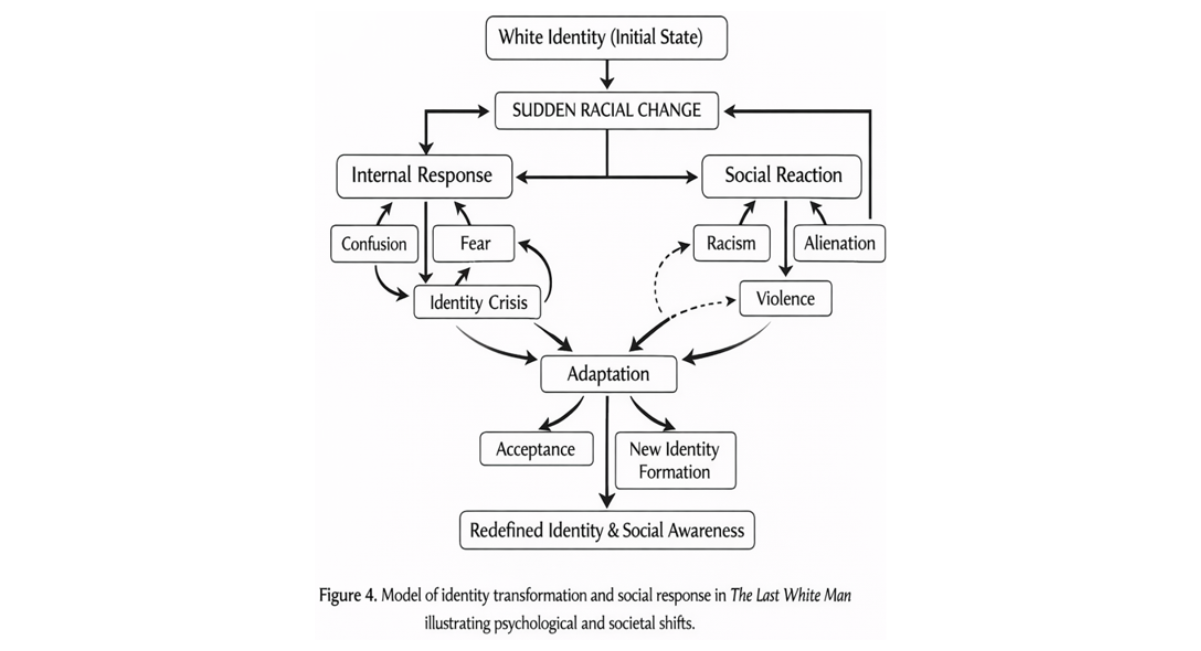
As the story progresses, both Anders and Oona evolve from passive observers to individuals confronting deep inner conflicts. Their journeys reveal the tension between personal emotion and social expectation. When Anders feels “seized with the idea” of digging his father’s grave Hamid, the act becomes more than a ritual; it reflects his search for connection, tradition, and meaning within a world that feels unstable. Similarly, Oona’s walk through her old neighborhood, where “lights start to glow against the evening” symbolizes the intersection of memory and transformation [6]. These moments highlight how Hamid uses physical movement and sensory imagery to represent emotional and psychological change. The spaces they inhabit become reflections of their internal struggles, blurring the line between identity and environment.
The peculiar strength of the novel becomes especially obvious in the way in which these individual feelings offer a hint to the overall mechanisms that define human experience. When the grandmother of Oona is in mood. “a potent sense of loss” and Anders is guilty about abandoning his father, these feelings are not exclusive; they refer to the social orders and value systems that define human relations [6]. The story does not directly preach about racial privilege or social inequality but it shows it through actions, silence or displacement of emotions. Fear, guilt, and confusion do not occur arbitrarily but serve as the reactions to the invisible social pressure. In this subtle style, Hamid proves that societal norms influence personal identity and relationships with other people and the extent to which they do it.
CONCLUSION
This paper was done to interpret The Last White Man by Mohsin Hamid under the umbrella of Critical Race Theory with the help of thematic analysis to understand how race, identity, and transformation are manifested throughout the novel. These results reveal that Hamid applies more than just individual experience to demonstrate the social and psychological structures that perpetuate the racial hierarchies. The novel reveals that racism, transformation, and fear are major themes and loss, guilt, confusion, modernity, violence, nature, and sex are among minor themes that define racial identity as the wobbly social construction that relies on fear, habit, and inherited privilege. Through the creation of a world in which whiteness does not exist, Hamid embraces the constructed reality of racial stability and asks his audience to confront the acute fear that comes with difference. His depiction of Anders and Oona gives us insight into the fact that personal and collective change is closely intertwined and change is not only physical but emotional, moral, and cultural. The straightforward and serene tone of the novel supports the criticism of the book by compelling the readers to rethink the manner in which the society determines who belongs and who does not. The work can make a contribution to the literature and cultural research in that it uses a thematic analysis along with the Critical Race Theory to provide a novel interpretation of how fiction can challenge the power of racial hegemony and envision a more inclusive and understanding human society.
RECOMMENDATIONS FOR FUTURE RESEARCHERS
Researchers in the future can expand this research by using alternative theoretical approaches like the postcolonialism, intersectionality, eco-criticism, or gender studies to The Last White Man to discover something new. The similarities of Hamid in his other novels such as The Reluctant Fundamentalist and Exit West could be used to indicate how Hamid manages to treat identity in different circumstances. Researchers can also explore the way the ideas of race and belonging of the novel are perceived by the readers belonging to different cultures. The cross-disciplinary work that relates literature to sociology or psychology can also be used to elaborate on how fiction can be viewed as a manifestation of social anxieties. These studies have the potential to further enrich our knowledge of how the modern day writing is still provoking and redefining the race, identity, and humanity in the modern world.
AUTHOR CONTRIBUTIONS
Ahsan Ullah (AU), the corresponding author, conceived and designed the study, selected the theoretical framework of Critical Race Theory for the thematic analysis, and led the overall interpretation of the novel's major and minor themes. He supervised the research process, drafted the core sections of the manuscript, and finalized the paper for submission. Similarly, Malalai Kakar (Mk) contributed to the literature review, assisted in identifying and organizing thematic categories from the text, and helped draft sections of the manuscript related to the analysis. However, Hifza Pari (HP) assisted in data (textual) collection, supported referencing and formatting in accordance with journal guidelines, and contributed to proofreading and revising the manuscript. Lastly, Shahida Nabi Bux (SNB) contributed to the review of relevant secondary literature, assisted in cross-checking textual excerpts against the primary source, and provided critical feedback on the discussion section during manuscript revision. All authors read and approved the final version of the manuscript.
CONFLICT OF INTEREST
The authors declare that they have no known competing financial interests or personal relationships that could have appeared to influence the work reported in this paper.
REFERENCES
- Achebe, C. Things Fall Apart. Anchor Books.
- Adichie, C. N. Americanah. Alfred A. Knopf.
- Tyson, L. Critical Theory Today: A User‑Friendly Guide (2nd ed.). Routledge.
- Nayar PK. Postcolonial literature: An introduction. Pearson Education India; 2008. [Google Scholar]
- Ashcroft, B., Griffiths, G., & Tiffin, H. The empire writes back: Theory and practice in post‑colonial literatures (2nd ed.). Routledge. Retrieved from.
- Hamid,M. The last white man. Riverhead Books.
- Ali H, Khadim N . Postcolonialism in Hamid’s The Last White Man. Pakistan Journal of Humanities and Social Sciences. 2024;12(2):2111-7. [Crossref] [Google Scholar]
- Delgado R, Stefancic J. Critical race theory: An introduction. NyU press; 2023. [Crossref] [Google Scholar]
- Crenshaw, K. (1991). Mapping the margins: Intersectionality, identity politics, and violence against women of color. Stanford Law Review, 43(6), 1241–1299. [Crossref]
- Ashraf, A., Mehmood, R., & Naseem, S. A critical reading of Hamid’s The Last White Man in the light of postmodernism. Journal of Law, Social and Management Sciences, 2(2), 8–12
- Masroor N, Khalid S, Rajab S. Exploring Racial Dynamics and Counter narratives in the Last White Man: Application of Critical Race Theory. Panacea Journal of Linguistics & Literature. 2024;3(1):215-24. [Google Scholar]
- Amir M, Iqbal M, Arshad W . The shifting hues of self: A magical realist exploration of identity and the politics of representation in The Last White Man by Mohsin Hamid. International Research Journal of Social Sciences and Humanities. 2024;3(1):679-92. [Google Scholar]
- Braun, V., & Clarke, V. Thematic analysis: A practical guide. SAGE Publications.
- Deshamukh, S. R. A thematic study of The Old Man and the Sea. Shri Raosaheb Ramrao Patil Mahavidyalaya, Savlaj.
- Yaya, E., & Sayra, Z. Thematic analysis of Solomon Hailemariam’s novel entitled The Young Crusader. Journal of Literature, Languages and Linguistics, 63, 18–27.
- Baldick C. The Oxford dictionary of literary terms. Oxford university press; 2015. [Google Scholar]
- Gunaratne, G. The Last White Man by Mohsin Hamid review – a hypnotic race fable. The Guardian.
- Ekpong MO. A Thematic and Stylistic Analysis of Aidoo’s Novels and Short Stories. LWATI: A Journal of Contemporary Research. 2011;8(3).
- Charles, R. Review of The Last White Man by Mohsin Hamid. The Washington Post.
- Menon, A. (2022). Review of The Last White Man by Mohsin Hamid. Frontline.
- A glimpse of a future without white people. Wired.
- Christian Science Monitor. (2022, August 1). Can white supremacy hold if no one is white? Christian Science Monitor.
- (2022, August 6). A post‑racial world: The Last White Man, by Mohsin Hamid. The Spectator.
- The Hindu. (2022). Review: The Last White Man is just a touch insipid (Andrew Whitehead). The Hindu.