
Journal of Mental Health Research and Innovation


ABSTRACT
Objective: This study was made to determine the effect of Domestic Violence and Broken Home on Children’s Self-esteem in Anka Local Government area of Zamfara State. To find out if Domestic Violence and Broken Home could significantly predict or have effect on children’s self-esteem.
Method: A total of 286 participants comprising 154 males and 132 females were selected through purposive sampling technique from four areas of Anka Local Government area which includes schools from Shiyar Magaji, Galadima, Sabon Gari and Shiyar Ajiya ranges from 12-18 years. Three instruments were used to collect data namely an Index of Family Relation (IFR) developed by Hudson (1982), Self-rating Broken Home developed by Hudson (1982) and an Index of Self-esteem (ISE) developed by Hudson (1982).
Results: Three hypotheses were tested with Pearson Product Moment correlation and t-test. The first hypothesis revealed that a significant negative correlation was found between domestic violence and Children Self-esteem, (r = -0.5, p < 0.05) which implies that Children who experience Domestic Violence suffer Low Self-esteem. Thus, the hypothesis is rejected. The second hypothesis revealed that children from Broken Homes do not significantly differ in self-esteem to those from intact Homes (t = 5.67, p < 0.05). Indicating that student from Broken Homes has significantly lower Self-esteem compare to those from intact Homes (p < 0.05). Thus, the hypothesis is rejected. The third hypothesis revealed that Domestic Violence and Broken Homes jointly account for 37.2% of the variance in Self-esteem. (R2 = 0.372). Both predictors have significant negative impact. Therefore, the hypothesis is rejected.
Conclusion: The study concluded that the aftermath effect of Domestic Violence and Broken Home on Children’s Self-Esteem often leaves the victims with the tendency to be timid, weak willed and Violent in the future overtime may predispose them to mental and physical health conditions.
Keywords: Domestic Violence; Broken Home; Low Self-esteem; Anka Local Government in Zamfara State; Nigeria
INTRODUCTION
Domestic violence is an act of human rights violation which may occur in homes or aftercare institutions where the victims can be women and children. It is a problem of individual’s attitude towards the other which can cause far reaching consequences for individual victims. Domestic violence can result in death, serious injuries and chronic medical and mental health issues for victims, their children, the perpetrators and others.
In 1993, the United Nations Declarations on the elimination of violence against women and children recognized domestic violence as one of the three contexts in which violence against women and children occurs. It is described as: physical, sexual and psychological violence occurring in the family, including battering, sexual abuse of female and male children in the household, dowry related violence, marital rape, female genital mutilation and other traditional practices harmful to women, children, non- spousal and violence related to exploitation.
The U.S government statistics shows that 95% of domestic violence cases involve women victims of male partners. The children of these women often witness domestic violence. The emotional responses of children who witness domestic violence may include fear, guilt, shame, sadness, depression and anger. Children who grow up observing their mothers abused by their father grow up with a role model of intimate relationship where one person uses violence over the other person to get their way.
According to Margolin, children raised in an abusive home learn that violence is an effective way to solve conflict and problems [1]. They may replicate the violence they witnessed as children in their teen and adult relationship. This goes with negative consequences including medical issues, mental health problems (e.g., depression, anxiety, low self-esteem, low self-worth and others), serious injuries and death. Reported that hostile home environments especially domestic violence lower child’s self-concept and self-worth [2,3]. Gidado, discovered that young children are sometimes exposed to criminality and other vices as a result of family dysfunction and have negative effect on their mental health [4]. And the recent study by Gidado reported the same effects to further buttress the effect of domestic violence, UNICEF indicates that Domestic Violence puts women at risk for negative health outcomes e.g., physical injury, mental health problems, sexually transmitted diseases, including HIV/AIDS and unwanted pregnancies [5,6]. Chineke, opined that unstable family including domestic violence will not be able to create an enabling environment for the child to do well in his education, as parents spend no time monitoring school work, supervising their children and also affects their mental health [7].
Similarly, Broken home is a place where the parents engage themselves in quarrelling, yelling, fighting, suspecting, keeping late hours to the detriment of the children’s primary drive for food, sleep and other basic needs. Broke home is one that is not structurally intact, as a result of conflict, separation, divorce, death of one of parent and illegitimacy, dropping out school. Broken homes are thus, affected by divorce, separation, death of one or both of the parents, desertion or single-parenthood.
Posits that broken home arise mainly from illegitimacy of children, the label of adopted child, conflict ridden home, separation, divorce and parental deprivation [8]. Such abnormal conditions of the home are likely to have a detrimental effect on children academic performance, self-concept, self-esteem and other forms of mental health conditions. He further indicated that, Life in a broken home or single parent family can be stressful for both the child and the parent. Such families are faced with challenges of inadequate financial resources. Apeh, have equally shown that domestic violence and broken homes among secondary school students may hinder the attainment of goals, particularly academic performance and over time develop to psychological problems [9].
Noted that if adolescents from unstable homes are to be compared with those from stable homes, it would be seen that those from the unstable home have more social, academic and psychological/emotional problems [10]. Thus, the family and its structure play a great role in children's academic performance and mental health. Furthermore, found that separation and instability in family structure often result in emotional distress and reduced self-esteem among adolescents [11]. He went further to say that children in our society know about the violence inherent in their Homes. Children in home where there is Domestic Violence are more likely to be abused and or neglected. Even if a Child is not physically harmed he or she may have emotional and behavioral problems. They can feel helpless, scared and upset. Children are harmed just by seeing and hearing the Violence and Broken Home. Children in the Violence and Broken Home may not get the care they need. They can have trouble sleeping in school and getting along with others. The above is not fair from a recent study done by [12,13,14].
Self-esteem in psychology is a Person’s overall subjective emotional evaluation of his or her own worth. It is a judgement of oneself as well as an attitude toward the self. Self-esteem encompasses beliefs about oneself Hewitt, while Smith, define it as "What we think about the self". Self-esteem is the positive or negative evaluation of the self, as in how we feel about it [15,16]. It is also the way of thinking, feeling and acting that implies level of acceptance, respect, trust and belief in oneself. reported that if the victim of Domestic Violence and Broken Home have low Self-esteem it can cause them to stay in abusive relationship [17]. This overtime can lead to serious injury, mental health issues (e.g., low self-esteem, low self-confidence, depression and others) and even death.
Furthermore, the combined predictive strength of Domestic Violence and Broken Homes on Self-esteem reinforces the theoretical frameworks in family systems theory, which posits that disturbances in the family unit directly affect child development. This also supported study done by Azuka-Obieke [18].
Research on these factors namely Domestic Violence and Broken Homes have not been done or conducted in Anka local government in the State of Zamfara especially with the worsening situation of insecurity, violence, banditry and “boko haram” being rampant in the Northern region of Nigeria which Zamfara State is among. This gap in the literature was filled in this study. This confirmed dearth of researchers in Nigeria investigating the impact of Domestic Violence and Broken homes on children’s Self-esteem. This study examined the impact of Domestic Violence and Broken Homes on Children’s Self-esteem among secondary school students in Anka local government area in Zamfara State
The following were hypothesized:
- Domestic violence will not significantly impact on self-esteem among secondary school students in Anka local government in Zafara State.
- Children from Broken Home will not significantly differ on self-esteem compared to those from intact homes among secondary school students in Anka local government in Zamfara State.
- There will be no significant relationship or association between domestic violence and broken homes on children self-esteem among secondary school students in Anka local government in Zamfara State.
MATERIALS AND METHODS
Participants
A total of 286 participants comprising 154 males and 132 females were selected through purposive sampling technique from four areas of Anka Local Government area which includes schools from Shiyar Magaji, Galadima, Sabon Gari and Shiyar Ajiya ranges from Junior Secondary School (JSS1-3) and Senior Secondary School (SS1-3) age 12-18 years. This sample size consists of three hundred and sixty (360) participants. The questionnaire was administered to the sample size of ninety participants per institution who were randomly selected from four different areas namely: Magaji, Galadima, Ajiya and Sabon Gari respectively accounting for three hundred and sixty respondents as the total sample size. 360 questionnaires were administered, however, from this 360-sample size, 34 questionnaires were damaged as a result of being torn, 40 questionnaires weren’t completely filled thus, incomplete and discarded/rejected while others were not returned. From this, 360 questionnaires minus 34 torn (questionnaires) plus 40 incomplete, discarded/rejected and those not returned (questionnaires) equal to 286 questionnaires (valid and adopted for the study). It was based on the above that 74 questionnaires or participants (34+40) were excluded/not used while the remaining 286 were considered valid and adopted for the study.
Instrument
Three psychological assessment instruments were completed by the participants in this study. They include: An Index of Family Relation questionnaire was developed by Hudson, Self-Rating Broken Home Scale (SRBHS) by Hudson and Index of self-esteem by Hudson [19].
Index of Family Relations (IFR) was developed by Hudson to measure the problem of interpersonal relationship in the family [19]. There is 25-item inventory design to measure the extent, severity, or magnitude of the problems that family members have in their relationships with one another. There is direct and reverse scoring of the items.
- Direct scoring: add together the values of the numbers shaded in the relevant items. For example, if in items 6,7,8,9,10,11 the numbers shaded are: 3, 2, 4, 1, 2, 5 respectively the score for the 6 items is 3 + 2 + 4 + 1 + 2 + 5 = 17
- Reverse Scoring: Change the values of the numbers from 1, 2, 3, 4, 5 to 5, 4, 3, 2, 1 respectively and add together the reversed values of the numbers shaded in the relevant items. For example if in items 13, 14, 15, 16, 17, 18 the numbers shaded are: 3, 2, 4, 1, 2, 5 respectively, the score for the 6 items is 3 + 4 + 2 + 5 + 4 + 1 = 19
- Direct Score items: 3, 6, 7, 9, 10, 11, 12, 13, 16, 19, 22, 24, 25.
- Reverse Score items: 1, 2, 3, 4, 5, 8, 14, 15, 17, 18, 20, 21 and 23.
- Add together the results of the direct and reverse scores to obtain a total score.
- Subtract 25 from the total score to obtain the client’s IFR score.
Reliability: Hudson reported an alpha coefficient of .95. While the psychometric properties of the scale for Nigeria provide test-retest co-efficient reliability of .80 by Anumba, [11]. obtained a divergent coefficient of .95 by correlating IFR and MMPI Psychopathic Deviate Scale (PDS) by Hewitt with Nigeria sample [20,21].
Self-Rating Broken Home (SRBHS) was developed by Hudson [19]. This scale measures experiences related to family instability, parental separation, conflict and emotional strain linked to broken home situations. It is a 25 items inventory questions which allows individual from broken home to rate him/her self on the impact of separation in their family to the client. It has two response option “True” or “False” to be responded by the client. It is directly scored by adding all responses. Higher scores indicate greater broken-home experiences. There are no reverse scored items. Interpretation include: scores 20–39 = Very Low Broken Home Experience, 40–59 = Moderate Experience, 60–79 = High Experience and 80–100 = Very High Experience While Validity: Elusiyan obtained a divergent coefficient of .95 by correlating IFR and MMPI Psychopathic Deviate Scale (PDS) by Hathaway with Nigeria sample [20,21].
Index of Self-esteem was also developed by Hudson to measure the level of self-esteem/self-concept [19]. There is 26-item inventory design “to measure the self-perceived and self-evaluative component of self-concept which is the sum total of the self-perceived and the other perceived views of the self-held by a person. The inventory is developed for individual above 12 years of age. There is direct and reverse scoring of the items.
- Direct Scoring: add together the values of the numbers shaded in the relevant items. For example, if in items 6,7,8,9,10,11 the numbers shaded are: 3, 2, 5, 4, 1, 2 respectively the score for the 6 items is 3 + 2 + 5 + 4 + 1 + 2 = 17
- Reverse Scoring: Change the values of the numbers from 1, 2, 3, 4, 5 to 5, 4, 3, 2, and 1 respectively and add together the reversed values of the numbers shaded in the relevant items. For example, if in items 13, 14, 15, 16, 17, 18 the numbers shaded are: 3, 2, 5, 4, 1, 2, respectively, the score for the 6 items is 3 + 4 + 1 + 2 + 5 + 4 = 19
- Direct Score items: 1, 2, 8, 9, 10, 11, 12, 13, 16, 17, 19, 20, 24.
- Reverse Score items: 3, 4, 5, 6, 7, 14, 15, 18, 21, 22, 23, 25.
- Add together the results of the direct and reverse scores to obtain the overall score.
- Subtract 25 from the total score to obtain the client’s ISE score.
Hudson reported an alpha coefficient of .93 and a two-hour rest-retest coefficient of .92 [19]. While Oniyghaiye, obtained the following coefficient of validity by correlating ISE with the stated tests: Concurrent validity with SCL-90 by Derogatis in scale C - interpersonal sensitivity = .46; scale D - Depression = .38 [2,3,22].
Procedure
Introductory letter was given to the institutions/schools for acceptance and permission to conduct the research and administer the questionnaires. Approval and acceptance was made. Researchers sort for their consent and confidentiality and later explained in details on the questionnaires. Thereafter, the questionnaires were administered. The ninety participants were randomly selected from the four different institutions located in the four areas namely: Magaji, Galadima, Ajiya and Sabon Gari Shiyar and accounting for three hundred and sixty respondents as the total sample size. From this 360-sample size, 34 questionnaires were damaged as a result of being torn, 40 questionnaires weren’t completely filled thus, incomplete and discarded/rejected while others were not returned/lost. From this, 360 questionnaires minus 34 torn (questionnaires) plus 40 incomplete, discarded/rejected and those not returned/lost (questionnaires) equal to 286 questionnaires (valid and adopted for the study). It was based on the above that 74 questionnaires or participants (34+40) were excluded/not used while the remaining 286 were considered valid and adopted for the study.
Design and statistics
This study adopted a correlational research design. The correlational design was to explore the effect of domestic violence and broken home on children’s self-esteem among Secondary School Students in Anka Local Government in Zamfara State, Nigeria. The independent variables (IVs) were Domestic Violence and Broken Homes while dependent variables (DVs) were Self-esteem of Secondary School of Anka local government area in Zamfara state. Data was presented in tables and analyzed using descriptive and inferential statistics, employing frequency counts and simple percentages. Statistical package for social sciences (SPSS) version 27 was used to analyze the data using hierarchical regression analysis, Pearson product moment condition and T test.
RESULT
|
Description |
Frequency |
Percentage (%) |
|
Questionnaires Distributed |
360 |
100% |
|
Questionnaires Returned (Valid) |
286 |
79.40% |
|
Questionnaires Damaged |
34 |
10% |
|
Questionnaires Incomplete and Rejected |
40 |
11.10% |
Table 1: Response Rate Summary
Demographic Data of Respondents
The demographic characteristics of respondents include age, gender, and class level (JS1–3 and SS1–3). This section helps provide context for understanding the analysis.
|
Age Range (Years) |
Frequency |
Percentage (%) |
|
12–14 |
58 |
20.30% |
|
15–16 |
144 |
50.30% |
|
17–18 |
84 |
29.40% |
Table 2: Age Distribution
Respondents ranged between ages 12 to 18, categorized.
|
Gender |
Frequency |
Percentage (%) |
|
Male |
154 |
53.80% |
|
Female |
132 |
46.20% |
Table 3: Gender Distribution
|
Class |
Frequency |
Percentage (%) |
|
JSS 1–3 |
138 |
48.30% |
|
SSS 1–3 |
148 |
51.70% |
Table 4: Class Level
|
Variable |
Minimum Score |
Maximum Score |
Mean |
Standard Deviation |
|
Index of Family Relation (IFR) |
18 |
96 |
53.24 |
11.85 |
|
Index of Self-Esteem (ISE) |
21 |
92 |
57.18 |
10.62 |
Table 5: Descriptive Statistics of Major Variables
Interpretation:
- The mean IFR score (53.24) suggests a moderate level of family relational problems among the respondents.
- The mean ISE score (57.18) implies an average self-esteem level, with variations among students depending on their home background.
|
Variables |
r-value |
p-value |
Decision |
|
Domestic Violence & Self-Esteem |
-0.56 |
0.001 |
Rejected |
Table 6: Correlation Between Domestic Violence and Self-Esteem
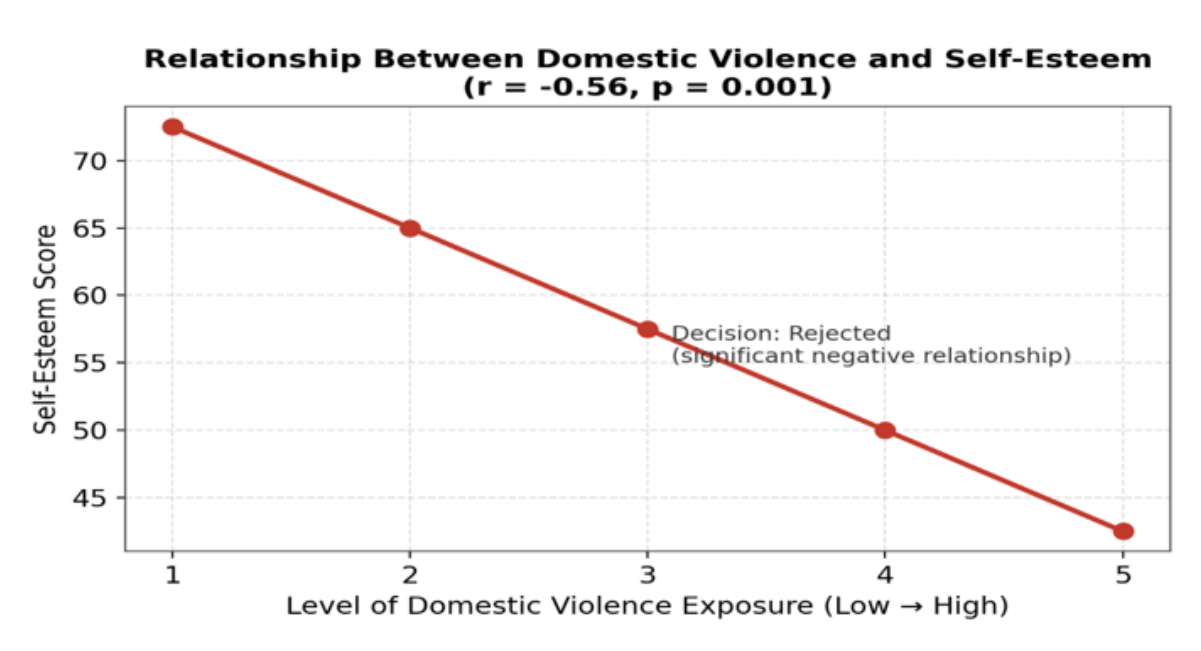
Figure 1: Line graph illustrating the negative relationship between domestic violence exposure and self-esteem (r = -0.56, p = 0.001).
|
Group |
Mean ISE Score |
SD |
t-value |
p-value |
Decision |
|
Broken Homes |
52.34 |
10.51 |
5.67 |
0 |
Rejected |
|
Intact Homes |
60.02 |
9.86 |
Table 7: t-Test of Mean ISE Score by Family Type
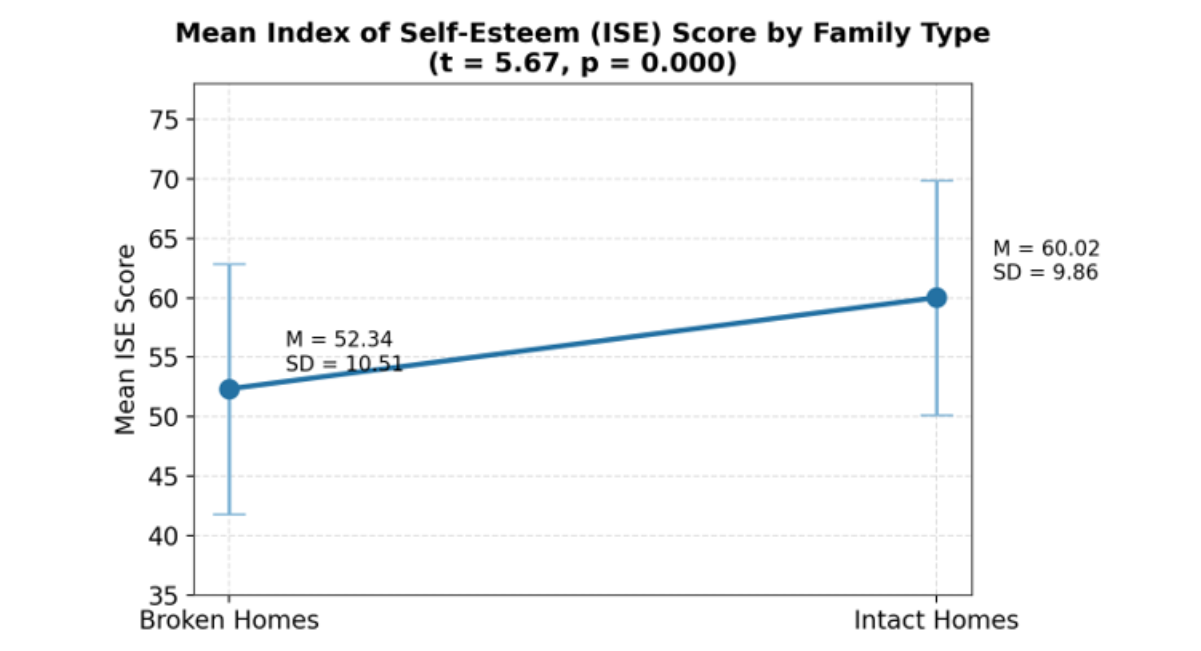
Figure 2: Line graph comparing mean Index of Self-Esteem (ISE) scores between broken and intact homes, with error bars representing standard deviation (t = 5.67, p = 0.000).
|
Model |
β (Beta) |
t-value |
R |
R² |
F-value |
p-value |
|
Domestic Violence |
-0.41 |
-6.32 |
0.61 |
0.372 |
14.89 |
0 |
|
Broken Home |
-0.36 |
-5.18 |
0 |
Table 8: Regression Analysis of Predictors of Self-Esteem
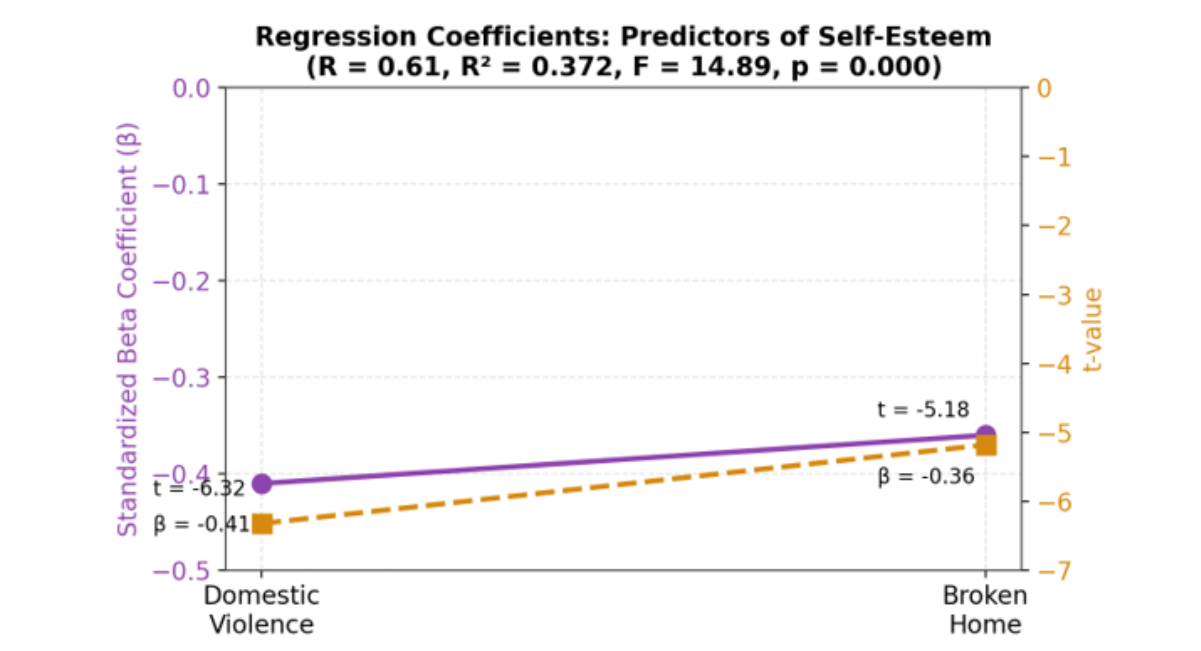
Figure 3: Line graph of standardized beta coefficients and t-values for domestic violence and broken home as predictors of self-esteem (R = 0.61, R² = 0.372, F = 14.89, p = 0.000).
Test of Hypotheses
Hypothesis 1: Domestic violence has no significant impact on children's self-esteem.
Statistical Test Used: Pearson Product Moment Correlation
Interpretation:
As shown in Table 6, A significant negative correlation was found between domestic violence and children's self-esteem (r = -0.56, p < 0.05). This implies that increased domestic violence is associated with lower self-esteem in children. Thus, the hypothesis is rejected.
Hypothesis 2: Children from broken homes do not significantly differ in self-esteem compared to those from intact homes.
Statistical Test Used: Independent Sample t-test
Interpretation:
As shown in Table 7, Students from broken homes have significantly lower self-esteem compared to those from intact homes (p < 0.05). Thus, the hypothesis is rejected.
Hypothesis 3: Domestic violence and broken homes will not jointly predict self-esteem among students.
Statistical Test Used: Multiple Regression Analysis
Interpretation:
As shown in Table 8, Domestic violence and broken homes jointly account for 37.2% of the variance in self-esteem (R² = 0.372). Both predictors have significant negative impacts. Therefore, the hypothesis is rejected.
Summary of Findings
- There is a significant negative relationship between domestic violence and students' self-esteem.
- Students from broken homes report significantly lower self-esteem than those from intact families.
- Domestic violence and broken homes significantly and jointly predict the self-esteem levels of students.
DISCUSSION
The results of this study reveal that Domestic Violence and Broken Homes significantly affected the self-esteem of secondary school children in Anka LGA, Zamfara State.
The findings align with Hudson, who emphasized that hostile Home Environments lower children’s self-concept and self-worth[4,5,9,17]. This also supported World Health Organization (WHO), that Domestic Violence puts women at risk for negative health outcomes e.g., physical injury, mental health problems, sexually transmitted diseases, including HIV/AIDS and unwanted pregnancies. Similarly, the significant difference in self-esteem between children from broken and intact homes is consistent with Anumba, who found that separation and instability in family structure often result in emotional distress and reduced Self-esteem among adolescents [4,5,7,13]. He also asserted that children in our society know about the violence inherent in their homes. Children in home where there is domestic violence are more likely to be abused and or neglected. Even if a Child is not physically harmed he or she may have emotional and behavioral problems. They can feel helpless, scared and upset. Children are harmed just by seeing and hearing the violence and broken home. Children in the Violence and Broken Home may not get the care they need. They can have trouble sleeping in school and getting along with others.
Furthermore, the combined predictive strength of Domestic Violence and Broken Homes on Self-esteem reinforces the theoretical frameworks in family systems theory, which posits that disturbances in the family unit directly affect child development. This also supported the study done by Azuka-Obieke [4,5,7,9,19,23].
CONCLUSION
The study concludes that: Domestic Violence has a significant negative effect on the Self-Esteem of Children. Children from Broken Homes suffer from lower Self-Worth compared to those from intact Homes. Both Domestic Violence and family separation are strong predictors of low self-esteem among school-aged Children. These findings stress the critical importance of maintaining a stable, non-violent home environment to support the psychological development of adolescents.
ACKNOWLEDGEMENT
The authors acknowledge the acceptance, support, approval and permission of the respective institutions/schools to conduct the study in the four areas namely Shiyar Magaji, Galadima, Sabon Gari and Shiyar Ajiya of Anka Local Government Area of Zamfara State. Special thanks to Clinical Psychologists who assisted in administering the questionnaires and Secondary School Students for their co-operation and participation in the study
CONSENT STATEMENT
The students gave written informed consent.
CONFLICT OF INTEREST
The authors declare no conflicts of interest.
FUNDING
The authors did not receive any specific funding for the study
REFERENCES
- Margolin G. Effects of domestic violence on children. [Crossref] [Google Scholar]
- Oniyghaiye AT. Validation of Index of Self-Esteem for Nigerian adolescents. Lagos: Psychology Publishers.
- Onighaiye MA. Social phobia among university students and its relation to self-esteem and body image. [PubMed]
- Gidado, BK & Diffang, AD. Family Dysfunction and Parental Role Abdication as Predisposing Factors for Drug Abuse among Secondary School Adolescents and Youths in the Federal Capital Territory, Abuja, Nigeria. International Journal Social Science and Humanity Research, vol 06(06), p 01 – 12.
- Gidado BK, Zubair & Taiye H. Impact 0f Broken Homes on Personality Disorder and Academic Performance of Senior Secondary School Students In The Federal Capital Territory Abuja, Nigeria. Contemporary Journal of Education and Development.
- Behind closed doors: The impact of domestic violence on children. The Body Shop International; 2006. [Google Scholar]
- Chineke, TC & Chidiezie-Chineke, JI. Impacts of Single Parenthood on the academic performance of secondary school students in Imo State. IMSUCDS International Journal of Development, 6, 201-216. [Google Scholar]
- Astone NM, McLanahan SS. Family structure, parental practices and high school completion. American sociological review. 1991:309-20. [Crossref] [Google Scholar]
- Apeh, HA Gidado, BK & Diffang, AD. School-Related Factors and Mental Health Issues among Adolescents in Public Senior Secondary Schools in Federal Capital Territory, Abuja, Nigeria. Journal of Social Studies and Civic Educators Association of Nigeria (JOSOCEAN).
- Schultz G. Broken Family Structure Leads to Educational Difficulties for children. Journal of Educational Psychology.
- Anumba C. (1995). Psychometric properties of family relation index in Nigerian context. Enugu: University of Nigeria Press.
- Azeez FM, Iheanyichukwu T, Femi–Adeoye KO, Brown RI & Raheem AO. The Impact of Domestic Violence Exposure on Academic Performance Among Junior Secondary School Students in Oyo West Local Government Area of Oyo State. International Journal of Innovative Psychology & Social Development 14 (1):94-101, Jan.-Mar.
- Bello, MI. Relationship between childhood emotional abuse, self-esteem and deviant behavior among university students’. Near East University.
- Obikwelu CL, Iheakaghchi OI, Ngwoke DU, Aye EN. School Violence and the Nigerian Child: Classroom Teacher Perspectives. International Journal of Innovative Research and Development. 2022 Jan 31;11(1). [Google Scholar]
- Hewitt JP. Oxford Handbook of Positive Psychology. Oxford University Press.
- Smith ER. & Mackie DM. Social Psychology 3rd Ed. Hove: Psychology Press.
- Draucker CB. Domestic violence: the challenge for nursing. Online Journal of Issues in Nursing. 2002;7(1). [Crossref] [Google Scholar] [PubMed]
- Azuka-Obieke U. Single-parenting, psychological well-being and academic performance of adolescents in Lagos, Nigeria. Journal of Emerging Trends in Educational Research and Policy Studies. 2013;4(1):112-7. [Google Scholar]
- Hudson WW. (1982). Index of Self-esteem, The Clinical Measurement Package: A field manual. Chicago: Dorsey Press.
- Elusiyan BA. Relationship between bond family bond, parental education, socio-economic status and development of delinquency. Department of Psychology University of Lagos.
- Hathaway SR. & Mc Kinley JC. Minnesota Multiphasic Personality Inventory: Manual. New York: The psychological Corporation.
- Derogatis LR, Lipman RS, Covi L. SCL-90: an outpatient psychiatric rating scale–preliminary report. Psychopharmacol bull. 1973;9(1):13-28. [Google Scholar] [PubMed].
- Caroline PA. & Xavier, GG. (2020). Impact of domestic violence on children: causes and preventive space measures. BCM Journal of Social Work (EBJSW), 16 (1), June.