About the Journal
Overview
Journal of Advanced Materials and Nanoengineering is an international, peer-reviewed scholarly journal dedicated to publishing high-quality research in materials science, nanotechnology, and nanoscale engineering. The journal serves as a global platform for scientists, engineers, and researchers to share innovative discoveries that advance the design, characterization, and application of advanced materials.
The journal focuses on cutting-edge developments in nanomaterials, functional materials, smart materials, and high-performance composites. It encourages research that bridges fundamental material science with practical engineering applications, promoting technological progress across industries such as electronics, energy, healthcare, aerospace, and environmental systems.
The Journal of Advanced Materials and Nanoengineering welcomes original research articles, review papers, short communications, and technical reports covering areas including nanofabrication, material synthesis, surface engineering, biomaterials, energy storage materials, semiconductor technologies, and computational material modeling. Interdisciplinary studies integrating physics, chemistry, engineering, and applied sciences are particularly encouraged.
Committed to academic excellence and ethical publishing standards, the journal follows a rigorous peer review process to ensure scientific integrity, originality, and relevance. By fostering innovation at the nanoscale and beyond, the journal aims to contribute to the development of next-generation materials and sustainable technological solutions worldwide.
Aim and Scope
The Journal of Advanced Materials and Nanoengineering is devoted to publishing impactful research that drives progress in advanced materials science and nanoscale engineering. The journal’s primary objective is to support innovative investigations into the development, optimization, and application of materials with enhanced structural, functional, and technological properties. It serves as an international forum for researchers and engineers working to translate material innovations into practical engineering solutions.
The journal accepts original research papers, review articles, brief communications, and technical studies that present novel insights and experimentally or theoretically validated findings. It encourages multidisciplinary contributions that combine materials chemistry, solid-state physics, mechanical engineering, nanotechnology, and computational modeling to create next-generation material systems.
Its scope encompasses a wide range of topics, including:
-
Design and fabrication of nanostructured materials
-
High-performance composites and multifunctional materials
-
Smart and responsive material systems
-
Biomaterials and nano-enabled medical applications
-
Materials for renewable energy and energy storage
-
Electronic, magnetic, and photonic materials
-
Thin films, coatings, and surface modification technologies
-
Micro- and nano-manufacturing processes
-
Simulation and computational analysis of material behavior
-
Environmentally sustainable and recyclable materials
-
Mechanical reliability and durability of engineered materials
-
Additive manufacturing and advanced processing techniques
The journal particularly values research that demonstrates scalability, industrial relevance, and environmental responsibility. Studies that bridge fundamental material research with applied nanoengineering solutions are strongly encouraged.
By promoting high standards of scientific integrity and innovation, the Journal of Advanced Materials and Nanoengineering aims to contribute to the advancement of material technologies that support modern industry, sustainable development, and future scientific breakthroughs.
Editorial and Peer-Review Policy
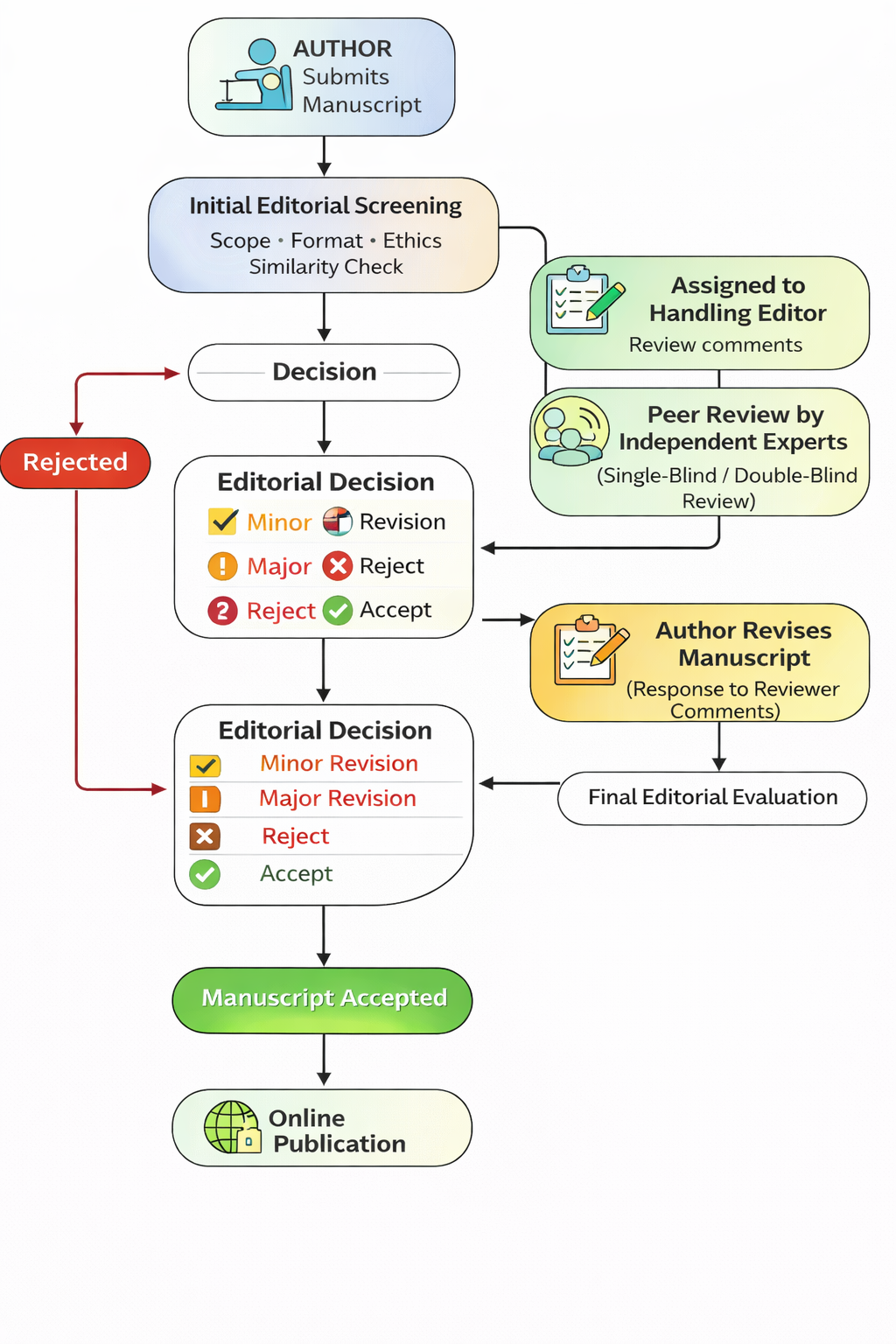
Journal of Advanced Materials and Nanoengineering adheres to a strict single-blind peer-review process to maintain the quality, integrity,
and scientific validity of all published work.
Key features include:
-
Each manuscript is reviewed by at least two independent experts in the field,
along with an academic editor.
-
Reviewers know who the authors are, but the authors remain unaware of the reviewer's
identities.
-
The evaluations emphasize scientific merit, originality, methodological rigor, ethical
compliance, and how well the work fits within the journal's scope.
-
Every submission goes through plagiarism checks and ethical compliance assessments
before the review process begins.
-
The final decision on publication is based on the reviewer's recommendations and the
editor's evaluation.
Publication Frequency & Format
This journal comes out Bi-Annual (Two issues per year). Accepted articles are
made available online in both HTML and PDF formats, ensuring that scholarly work is accessible
and disseminated promptly.
Open Access Policy
Journal of Advanced Materials and Nanoengineering operates under a fully open access model. This means all published content is freely
accessible to readers around the globe, without any subscription or paywall. Authors maintain
the copyright to their work, and the content is shared under an appropriate open-access license.
Indexing & Archiving
Journal of Advanced Materials and Nanoengineering is dedicated to upholding high standards with the goal of being included in reputable
scientific indexing and abstracting services. The journal also ensures long-term digital
preservation through recognized archives and repositories, guaranteeing permanent access and
discoverability.
Manuscript Submission
Authors are encouraged to submit their manuscripts through the journal's Online Submission
System (Submit Manuscript) or by emailing them directly to the
Editorial Office at
support@researchpubx.com.
Manuscripts must adhere to the journal's author guidelines regarding structure, formatting,
referencing style, ethical approvals, and necessary disclosures (such as conflicts of interest
and funding).
Publication Ethics & Integrity
Journal of Advanced Materials and Nanoengineering follows internationally recognized standards for publication ethics and research integrity,
which include (but are not limited to):
- Make sure you have ethical approval.
- Ensure informed consent and guarantee confidentiality.
- Declare any conflicts of interest.
- Be transparent about data availability.
- Clarify authorship criteria and the roles of contributors.
- Conduct anti-plagiarism checks.
- Have a clear policy for retraction and correction.