About the Journal
Overview
Journal of Mental Health and Behavioral Sciences (JMHB) is an international, peer-reviewed, open-access forum for high-quality research at the intersection of mental health and human behavior. We are dedicated to advancing scientific knowledge and clinical practice by publishing studies that explore the multifaceted interplay of psychological, biological, social, and environmental factors.
Our mission is to bridge the gap between scientific discovery and real-world application. We prioritize research that informs evidence-based policy, refines clinical interventions, and deepens public understanding of mental health. By fostering a global dialogue among researchers, clinicians, educators, and policymakers, JMHB aims to contribute to the prevention and treatment of mental health disorders and the promotion of psychological well-being across the entire lifespan.
Aim and Scope
The Journal of Mental Health and Behavioral Sciences is a premier international, peer-reviewed, and open-access forum dedicated to advancing the scientific foundation and clinical practice at the nexus of mental health, psychology, neuroscience, and human behavior. Our mission is to disseminate high-impact research that deepens our understanding of mental processes and translates into tangible improvements in mental well-being, the prevention and treatment of mental disorders, and the enhancement of behavioral health outcomes for diverse populations globally.
We champion an interdisciplinary approach, welcoming contributions that bridge traditional boundaries and span the full continuum of mental and behavioral health. Our scope encompasses, but is not limited to, the following key areas:
- Clinical Psychology and Psychiatry: Research addressing the etiology, assessment, diagnosis, and treatment of mental disorders, including mood and anxiety disorders, trauma-related conditions, psychotic, personality, and substance use disorders.
- Behavioral Neuroscience and Psychobiology: Investigations into the biological underpinnings of behavior, emotion, and cognition, utilizing genetic, neurochemical, neuroimaging, and psychophysiological methodologies to understand psychopathology.
- Developmental and Lifespan Perspectives: Studies examining mental health trajectories from childhood through aging, with an emphasis on developmental processes, the impact of early-life experiences, and factors promoting resilience across the lifespan.
- Social, Cultural, and Community Mental Health: Explorations of how sociocultural determinants, family dynamics, community contexts, stigma, and socioeconomic inequities shape mental health expression, access to care, and outcomes.
- Intervention and Therapeutic Research: Efficacy and effectiveness studies of psychological, pharmacological, and integrative interventions, including psychotherapies, cognitive-behavioral therapies, mindfulness, digital mental health tools, and rehabilitation programs.
- Prevention Science and Public Mental Health: Research focused on mental health promotion, preventive interventions, mental health literacy, policy analysis, and population-level strategies designed to mitigate the burden of mental illness.
- Health Psychology and Behavioral Medicine: The interplay between psychological factors and physical health, covering chronic disease management, health behavior change, stress and coping, treatment adherence, and psychosomatic medicine.
- Forensic and Legal Psychology: The application of mental health science to legal contexts, including the study of criminal behavior, risk assessment, competency evaluations, offender rehabilitation, and victimology.
- Occupational, Organizational, and Educational Mental Health: Research addressing well-being, burnout, performance, and mental health supports within workplace, school, and organizational settings, alongside the evaluation of intervention programs.
- Innovative Methods and Interdisciplinary Approaches: Advances in research methodologies, assessment tools, qualitative and mixed-methods designs, data analytics, and conceptual models that integrate diverse disciplinary perspectives.
The journal invites submissions of original research articles, systematic reviews and meta-analyses, narrative reviews, brief reports, clinical case studies, theoretical papers, and scholarly commentaries. By fostering a global dialogue among researchers, clinicians, educators, policymakers, and advocates, we aim to accelerate the translation of knowledge into practice and contribute to building mentally healthier societies.
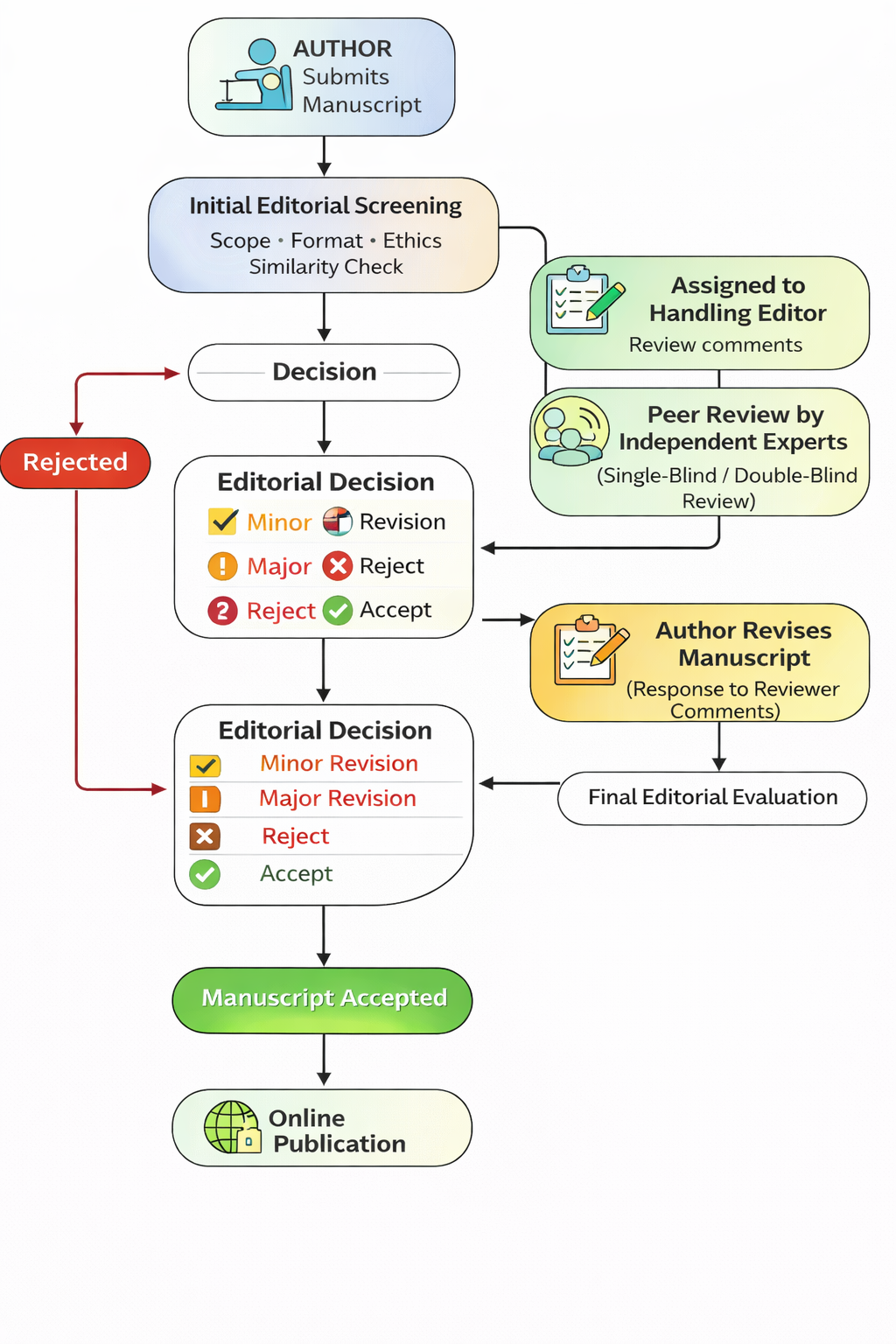
- pass this initial screening proceed to the Editor-in-Chief or a designated Associate Editor for a preliminary scientific assessment. Those deemed to have insufficient priority, originality, or methodological rigor may be rejected without external review.
- Peer Review: Manuscripts that pass the editorial assessment are assigned to at least two independent, expert reviewers. Reviews are conducted in a single-blind manner, where the identities of both the authors and reviewers are concealed. This process ensures that manuscripts are evaluated solely on their scientific merit, originality, and clarity, free from bias.
- Review and Decision: Reviewers are asked to provide a detailed, constructive evaluation of the work. Based on the reviewers' reports and their own assessment, the handling Editor makes a final decision, which may be: Accept, Minor Revision, Major Revision, or Reject. The editorial team is committed to providing authors with clear, timely, and respectful decisions and feedback.
Editorial and Peer-Review Policy
Journal of Mental Health and Behavioral Sciences adheres to a strict single-blind peer-review process to maintain the quality, integrity,
and scientific validity of all published work.
Key features include:
-
Each manuscript is reviewed by at least two independent experts in the field,
along with an academic editor.
-
Reviewers know who the authors are, but the authors remain unaware of the reviewer's
identities.
-
The evaluations emphasize scientific merit, originality, methodological rigor, ethical
compliance, and how well the work fits within the journal's scope.
-
Every submission goes through plagiarism checks and ethical compliance assessments
before the review process begins.
-
The final decision on publication is based on the reviewer's recommendations and the
editor's evaluation.
Publication Frequency & Format
This journal comes out Bi-Annual (Two issues per year). Accepted articles are
made available online in both HTML and PDF formats, ensuring that scholarly work is accessible
and disseminated promptly.
Open Access Policy
Journal of Mental Health and Behavioral Sciences operates under a fully open access model. This means all published content is freely
accessible to readers around the globe, without any subscription or paywall. Authors maintain
the copyright to their work, and the content is shared under an appropriate open-access license.
Indexing & Archiving
Journal of Mental Health and Behavioral Sciences is dedicated to upholding high standards with the goal of being included in reputable
scientific indexing and abstracting services. The journal also ensures long-term digital
preservation through recognized archives and repositories, guaranteeing permanent access and
discoverability.
Manuscript Submission
Authors are encouraged to submit their manuscripts through the journal's Online Submission
System (Submit Manuscript) or by emailing them directly to the
Editorial Office at
support@researchpubx.com.
Manuscripts must adhere to the journal's author guidelines regarding structure, formatting,
referencing style, ethical approvals, and necessary disclosures (such as conflicts of interest
and funding).
Publication Ethics & Integrity
Journal of Mental Health and Behavioral Sciences follows internationally recognized standards for publication ethics and research integrity,
which include (but are not limited to):
- Make sure you have ethical approval.
- Ensure informed consent and guarantee confidentiality.
- Declare any conflicts of interest.
- Be transparent about data availability.
- Clarify authorship criteria and the roles of contributors.
- Conduct anti-plagiarism checks.
- Have a clear policy for retraction and correction.