About the Journal
Overview
About the Journal of Environmental Resilience and Adaptation (JERA)
The Journal of Environmental Resilience and Adaptation (JERA) is a leading international, peer-reviewed forum for research that strengthens the capacity of natural and human systems to withstand, adapt to, and recover from environmental change. We provide a dynamic platform where scientists, policymakers, engineers, and practitioners converge to share actionable solutions for pressing challenges like climate variability, ecological degradation, and emerging environmental risks.
JERA champions interdisciplinary research that bridges environmental science, climate adaptation, sustainability planning, and resilient infrastructure. By integrating rigorous scientific evidence with practical, on-the-ground strategies, we aim to foster long-term environmental stability and enhance community resilience worldwide.
We invite original research, reviews, case studies, policy analyses, and technical notes across a broad spectrum of topics, including:
-
Climate change adaptation, mitigation, and decarbonization pathways
-
Ecosystem resilience, biodiversity conservation, and ecological restoration
-
Disaster risk reduction and comprehensive preparedness
-
Resilience of water, soil, and coastal systems
-
Sustainable urban and rural development
-
Environmental governance, climate policy, and finance
-
Nature-based solutions and green infrastructure
-
Circular economy and sustainable resource management
JERA is distinguished by its emphasis on real-world applicability. We prioritize contributions that offer data-driven insights, innovative methodologies, community-based adaptation models, and robust policy frameworks that directly support the UN Sustainable Development Goals (SDGs). Committed to the highest standards of research integrity and ethical publishing, JERA fosters global collaboration to build a more sustainable and resilient future.
Aim and Scope
The Journal of Environmental Resilience and Adaptation (JERA) is a leading interdisciplinary forum for research at the interface of human societies and natural systems. We publish a range of contributions—from original research and reviews to policy analyses and case studies—that advance our understanding of environmental change and inform pathways toward a resilient and sustainable future. Our mission is to bridge the gap between ecological integrity and human well-being in an era of rapid global transformation.
Scope & Key Themes
We welcome submissions across a broad spectrum of topics, including but not limited to the following areas:
Core Earth & Climate Systems
-
Climate dynamics, modeling, and downscaling.
-
Extreme event attribution (droughts, floods, heatwaves).
-
Carbon cycling, biogeochemical feedbacks, and paleoclimatology.
-
Tipping points, planetary boundaries, and irreversible change.
Ecosystems, Biodiversity & Nature-based Solutions
-
Ecosystem structure, function, and resilience (terrestrial, freshwater, marine).
-
Biodiversity-ecosystem functioning and species distribution modeling.
-
Habitat connectivity, rewilding, and restoration ecology.
-
Design and evaluation of nature-based solutions (e.g., mangrove restoration, green-gray infrastructure).
Socio-Ecological Systems & Resilience Thinking
-
Theoretical and empirical advances in resilience, panarchy, and adaptive cycles.
-
System dynamics modeling of coupled human–nature systems.
-
Societal adaptation, transformation, and collapse.
-
Integration of cultural, Indigenous, and local knowledge.
Water Security & Aquatic Systems
-
Hydrological modeling, groundwater management, and water governance.
-
Water quality, pollution control, and flood risk mitigation.
-
Marine and coastal resilience, sea-level rise, and blue carbon ecosystems.
Governance, Policy & Social Equity
-
Adaptive governance, institutional design, and polycentric decision-making.
-
Climate adaptation planning, disaster risk reduction (DRR), and the Sendai Framework.
-
Environmental, climate, and energy justice; gender and intersectional vulnerability.
-
Rights of Indigenous Peoples and local communities (IPLCs).
-
Conflict, environmental security, and climate-induced migration.
Urban Systems & Infrastructure
-
Climate-resilient urban planning, smart cities, and green infrastructure.
-
Urban metabolism, circular economy, and waste-to-resource systems.
-
Urban heat island mitigation, building efficiency, and informal settlement adaptation.
Food Systems & Agriculture
-
Climate-smart agriculture, agroecology, and soil health.
-
Crop modeling, yield forecasting, and livelihood diversification.
-
Food system resilience, supply chains, and food sovereignty.
Health & Well-being in a Changing Environment
-
Climate-sensitive infectious diseases and environmental health (air quality, heat stress).
-
Mental health impacts of environmental change.
-
One Health/Planetary Health approaches to zoonotic spillover and pandemic prevention.
Energy, Economy & Sustainable Transitions
-
Renewable energy systems, energy justice, and just transitions.
-
Low-carbon pathways, demand-side management, and life-cycle assessment.
-
Environmental economics, valuation of ecosystem services, and green finance.
-
Circular economy, material flows, and waste innovation.
Methods, Data & Digital Innovation
-
Geospatial science, remote sensing (satellite, UAV), and environmental monitoring.
-
AI/ML for climate prediction, pattern detection, and image classification.
-
Digital twins, IoT, and big data analytics.
-
Citizen science and participatory monitoring.
Transformative Pathways & Global Sustainability
-
Interactions and trade-offs among the Sustainable Development Goals (SDGs).
-
Governance of emerging risks (e.g., geoengineering, synthetic biology).
-
Science-policy interfaces, transdisciplinary action research, and scenario planning.
-
Environmental education, communication, and behavioral change.
Editorial and Peer-Review Policy
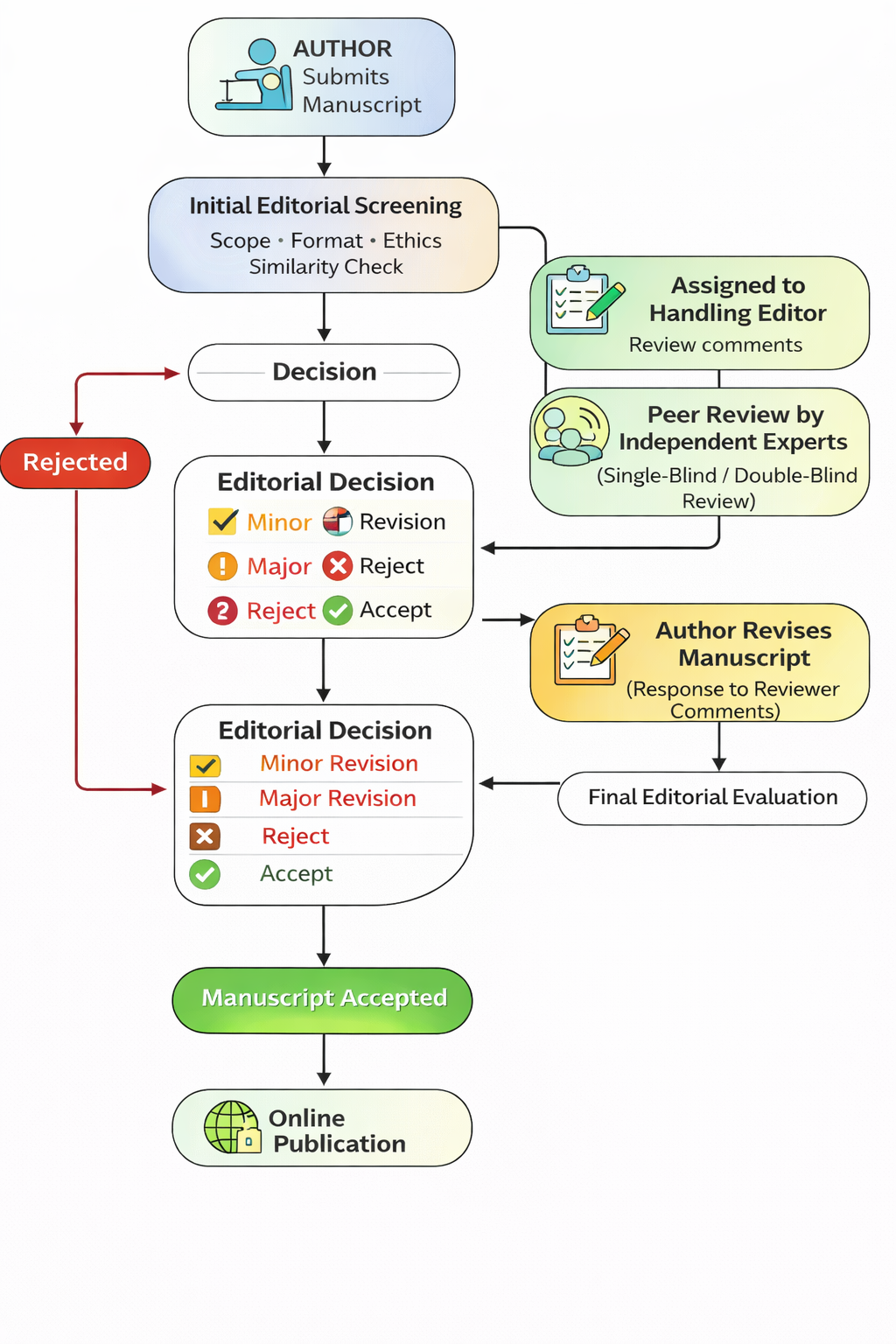
Journal of Environmental Resilience and Adaptation adheres to a strict single-blind peer-review process to maintain the quality, integrity,
and scientific validity of all published work.
Key features include:
-
Each manuscript is reviewed by at least two independent experts in the field,
along with an academic editor.
-
Reviewers know who the authors are, but the authors remain unaware of the reviewer's
identities.
-
The evaluations emphasize scientific merit, originality, methodological rigor, ethical
compliance, and how well the work fits within the journal's scope.
-
Every submission goes through plagiarism checks and ethical compliance assessments
before the review process begins.
-
The final decision on publication is based on the reviewer's recommendations and the
editor's evaluation.
Publication Frequency & Format
This journal comes out Bi-Annual (Two issues per year). Accepted articles are
made available online in both HTML and PDF formats, ensuring that scholarly work is accessible
and disseminated promptly.
Open Access Policy
Journal of Environmental Resilience and Adaptation operates under a fully open access model. This means all published content is freely
accessible to readers around the globe, without any subscription or paywall. Authors maintain
the copyright to their work, and the content is shared under an appropriate open-access license.
Indexing & Archiving
Journal of Environmental Resilience and Adaptation is dedicated to upholding high standards with the goal of being included in reputable
scientific indexing and abstracting services. The journal also ensures long-term digital
preservation through recognized archives and repositories, guaranteeing permanent access and
discoverability.
Manuscript Submission
Authors are encouraged to submit their manuscripts through the journal's Online Submission
System (Submit Manuscript) or by emailing them directly to the
Editorial Office at
support@researchpubx.com.
Manuscripts must adhere to the journal's author guidelines regarding structure, formatting,
referencing style, ethical approvals, and necessary disclosures (such as conflicts of interest
and funding).
Publication Ethics & Integrity
Journal of Environmental Resilience and Adaptation follows internationally recognized standards for publication ethics and research integrity,
which include (but are not limited to):
- Make sure you have ethical approval.
- Ensure informed consent and guarantee confidentiality.
- Declare any conflicts of interest.
- Be transparent about data availability.
- Clarify authorship criteria and the roles of contributors.
- Conduct anti-plagiarism checks.
- Have a clear policy for retraction and correction.